
USE CASE
AI continuity is your problem the moment someone else pulls the switch.
Congress is writing the shutdown authority. Providers are building the shutdown capability. Neither is planning for the hour after the switch is pulled, when the work stops on your side of the line.
AI continuity is the discipline of keeping approved work running when a model becomes unavailable. Not because you were promised it would never happen. Because you decided in advance what happens when it does.
Sixty seconds on the hour after the switch is pulled
They can switch it off. You can switch over. The routing layer that keeps eligible work running is the one you configure before the event, not during it.
What AI continuity means
AI continuity is the ability to keep eligible AI work running when a model is shut down, deprecated, restricted, or withdrawn, by routing that work to another approved model without rebuilding the workflow around it.
It is a design decision, not an incident response. The organizations that keep working through a model outage are the ones that separated the workflow from the model before the outage, not the ones that reacted quickly on the day.
The shutdown authority is being written for someone else
On July 23, 2026, Representatives Ted Lieu and Nathaniel Moran introduced the AI Kill Switch Act, H.R. 9917. The bill would authorize the Secretary of Homeland Security, the Secretary of Commerce, and the Director of National Intelligence to order the slowing or shutdown of an AI system judged capable of catastrophic harm, and would require covered developers to maintain the technical capability to throttle, suspend, or shut down their models, report incidents, and preserve forensic records.
The Senate is working a different design. On September 16, 2026, Senator John Kennedy sought unanimous consent to pass the AI Emergency Button Act, which would require an advanced model sold in the United States to carry a shutdown mechanism while leaving that switch with the company that owns the model rather than with any government. Senator Rand Paul objected and the request failed.
Read the two designs together. One puts the switch with the government. The other puts it with the developer. Neither puts it with the organization running the work, and neither owes that organization a way to keep operating.
That is the gap. The debate has been about whether the switch should exist and who should hold it. The organization running payroll explanations, claims triage, or engineering review through a model that gets switched off is not a party to that argument, and is not covered by its protections.
We take no position on whether either bill should pass. We take a firm position on what an operator should have in place either way.
A shutdown order is not the only way a model leaves
Legislation is the loudest case. It is not the most likely one.
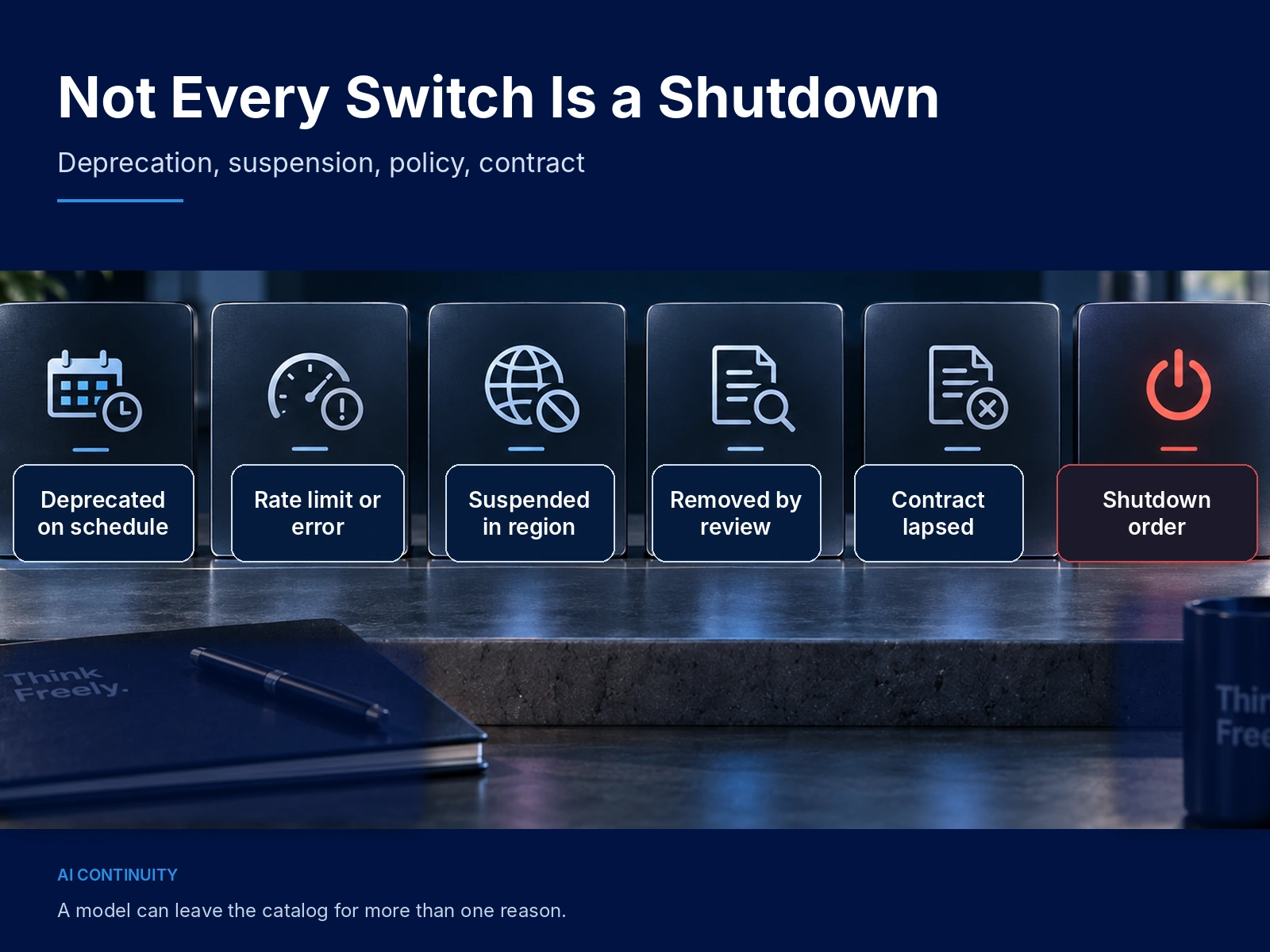
A model can leave your operating path for many reasons. A provider deprecates a version on a published schedule. A rate limit or a server error takes an endpoint out. A provider suspends service in a region. Your own security review removes a model from the approved catalog. A contract lapses.
Every one of these produces the same operational morning. Work that ran yesterday does not run today, and the question is whether an administrator can reroute it or an engineering team has to rewrite it.
AI continuity planning that only covers the government case covers the rarest case. When the decision is yours rather than someone else’s, the same mechanism runs deliberately, and the question becomes how to retire, replace, and compare models on your own terms.
Continuity runs on a stable name
The mechanism is a name your organization owns.
In RouteFreely, administrators define virtual models: stable names that map to real backends. A virtual model such as company-claims-assistant points at one provider today and a different one tomorrow. Users see the same name. Applications call the same endpoint. The mapping changes underneath.
This is what makes a model change an administrative action instead of a project. When the model is a replaceable dependency behind a name you control, removing it is a policy decision with an audit record.
Applications written for one vendor’s API keep working, because RouteFreely presents OpenAI-style, Anthropic-style, and Ollama-style protocol surfaces against the whole approved catalog. Integrations repoint once and gain the ability to change backends without being rewritten.

When an endpoint stops answering
Configure failover on a virtual model and RouteFreely moves the request when a backend returns a rate limit or a server error. You choose the shape: an ordered fallback list, a rotating list that spreads load, or automatic distribution across other endpoints serving the same underlying model.
A circuit breaker tracks failures per endpoint and takes a failing endpoint out of rotation until it recovers, so one degraded provider does not slow every request queued behind it. Health polling catches the problem before a user does.
Failover is configured per virtual model, which means you decide which workloads carry a second path and which do not. A model used for a nightly summarization job and a model used for live customer response do not need the same answer.
When the platform itself goes down
A secondary environment runs the full ThinkFreely stack live, not cold.
Health checks watch the primary. Traffic moves to the secondary within thirty to ninety seconds of a failure, automatically. Critical data synchronizes hourly, with large append-only stores synchronized nightly, which bounds worst-case data loss to the last sync interval.
Return to the primary is operator-initiated, never automatic. An unattended failback is how organizations lose data twice.
Those are the numbers. Put them next to whatever your current AI platform has told you about its recovery posture.
Refusal is a continuity feature
The failure that ends a compliance review is not an outage. It is work that quietly went somewhere it should not have gone.
When a group runs in local-only privacy mode, requests are routed exclusively to models running on infrastructure your organization controls. If no eligible local model is available, the request is refused rather than sent elsewhere.
The same discipline applies across the routing path, where work is matched to a model by capability, cost, privacy, and policy. Only models advertising the required capability are considered, so a request carrying an image is never sent to a text-only model. A hard usage limit rejects the request with a clear message and a reset time rather than billing through the ceiling.
An AI platform that always returns an answer is telling you it has no policy.
The rules survive the reroute
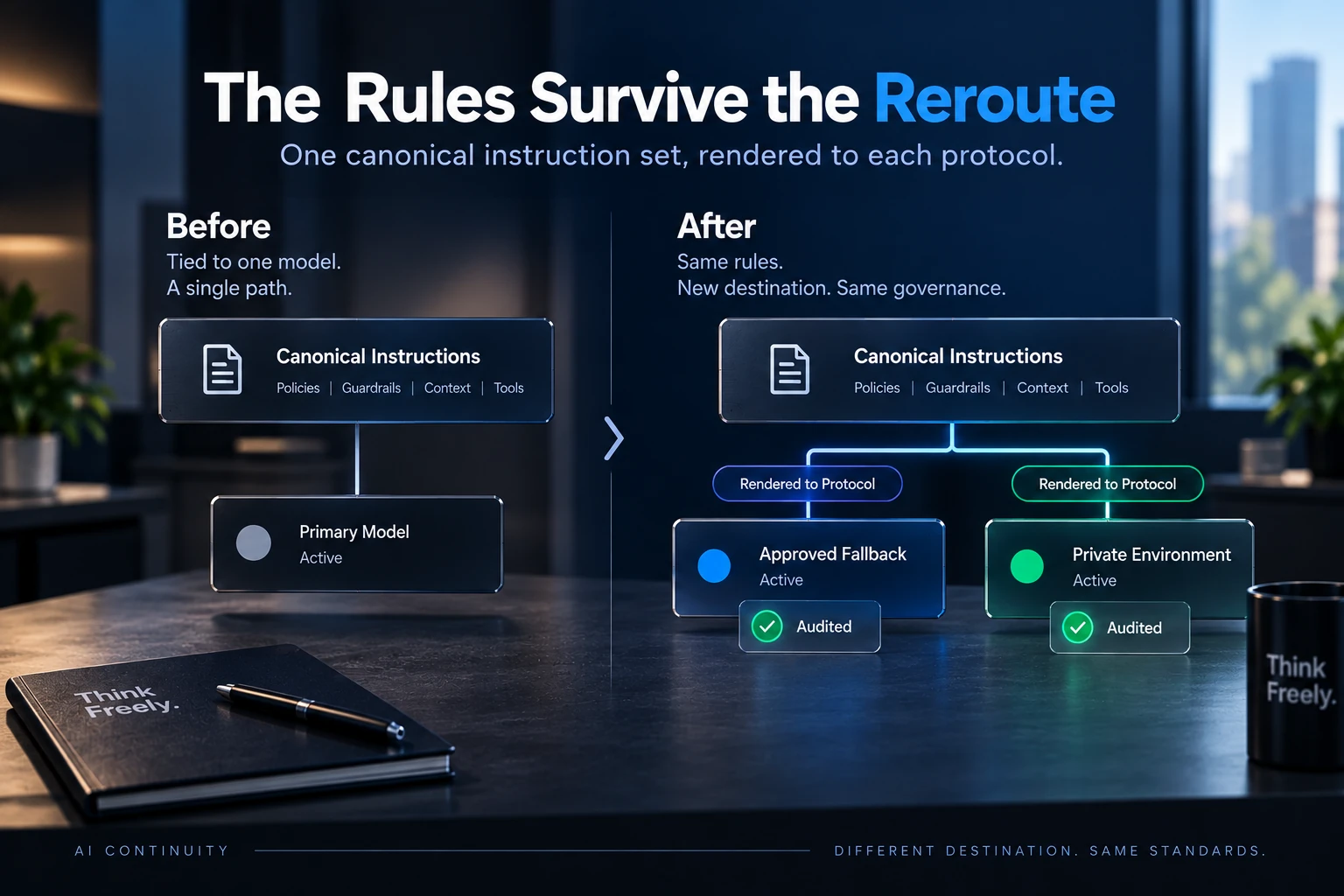
A reroute that changes the model must not change the instructions.
DriftHold holds your canonical instruction blocks and renders them into each request at the protocol the destination model expects. When work moves to an alternate path during an outage, requests on that path render from the same blocks, so policy does not depend on which backend answered. New providers become rendering targets rather than rewrite projects.
Every block change is audited. Permission to read or change a block is granted per key and per class.
DriftHold locks instructions, not outputs. Models remain probabilistic, and identical instructions do not produce identical text. What you get is the same governance reaching every model you route to.
What you can produce afterward
An incident is judged on what you can show.
ThinkFreely captures the stages of a request, including the point after instructions, tools, Skills, and retrieved knowledge have been assembled and before the request reaches the model. That record shows the difference between what a person typed and what the model actually received.
A conversation can be rebuilt turn by turn, with timestamps and roles, and exported as a standalone HTML file that opens anywhere and prints cleanly. When a user deletes a conversation in the workspace, the platform records the deletion and preserves the evidence of what was deleted. Retention runs in three tiers, live, archived, then purge, on schedules administrators set, with a permanent legal-hold flag.
Routing decisions are recorded with the tier and the reason attached. Token counts and cost are attributed per request to a user, an endpoint, a model, and an API key.
This is operational evidence, produced by the system that did the work. Treat it as the raw material your auditors and your regulators will ask for, and hold it to your own retention policy.
What continuity does not do
Provider-specific features do not transfer. A capability that exists only on one vendor’s model leaves when that model leaves, which is why it is worth knowing in advance which parts of your business context stay under your control.
Instructions often need tuning when a workload moves between model families. The routing change is immediate. The quality review is yours.
Routing quality equals policy quality. The platform enforces the policy you define, and vague classifications produce vague governance.
Independence is a posture you maintain, not a product you buy once. AI continuity is the part of that posture you can test before you need it.
Operating checks for AI continuity
Key questions to answer before the switch matters:
- which workflows would stop today if your primary model became unavailable
- which virtual models carry a configured second path, and which do not
- what your approved catalog would look like after removing a single provider
- whether sensitive workloads have an eligible local or private destination
- who is authorized to retire a model, and how that decision is recorded
- what evidence you could produce about work that ran in the hour before an outage
- which prompts and instructions would need review after a model family change
Recommended next step
Start with the workflows where one model has quietly become the foundation. We can show you what happens to them when that model is taken away, and what it takes to keep them running.