Design AI governance in the order that actually works.
Governance fails when it is designed as a wall. It works when it is designed as a path that is easier to follow than to avoid.
Governance is how AI scales without losing control. The design goal is control that supports adoption instead of suppressing it.
Start where the exposure is largest
Do not begin with every possible control. Begin with the controls that reduce the largest unmanaged exposure. A short list of high-risk categories, a few approved models, and clear ownership will do more than an exhaustive policy no one follows.
The layers to design
access policy across users, groups, models, tools, projects, and keys
identity integration, including OIDC and Entra, mapped to onboarding and offboarding
model approval: which models are allowed, for whom, and for what
tool governance through MCP, for whole servers and individual tools
privacy and data-boundary rules, including local-only routing for sensitive work
usage and cost policy, with hard and soft limits
skills and instruction governance, including DriftHold for authoritative instructions
a review cadence, because usage changes what policy should say
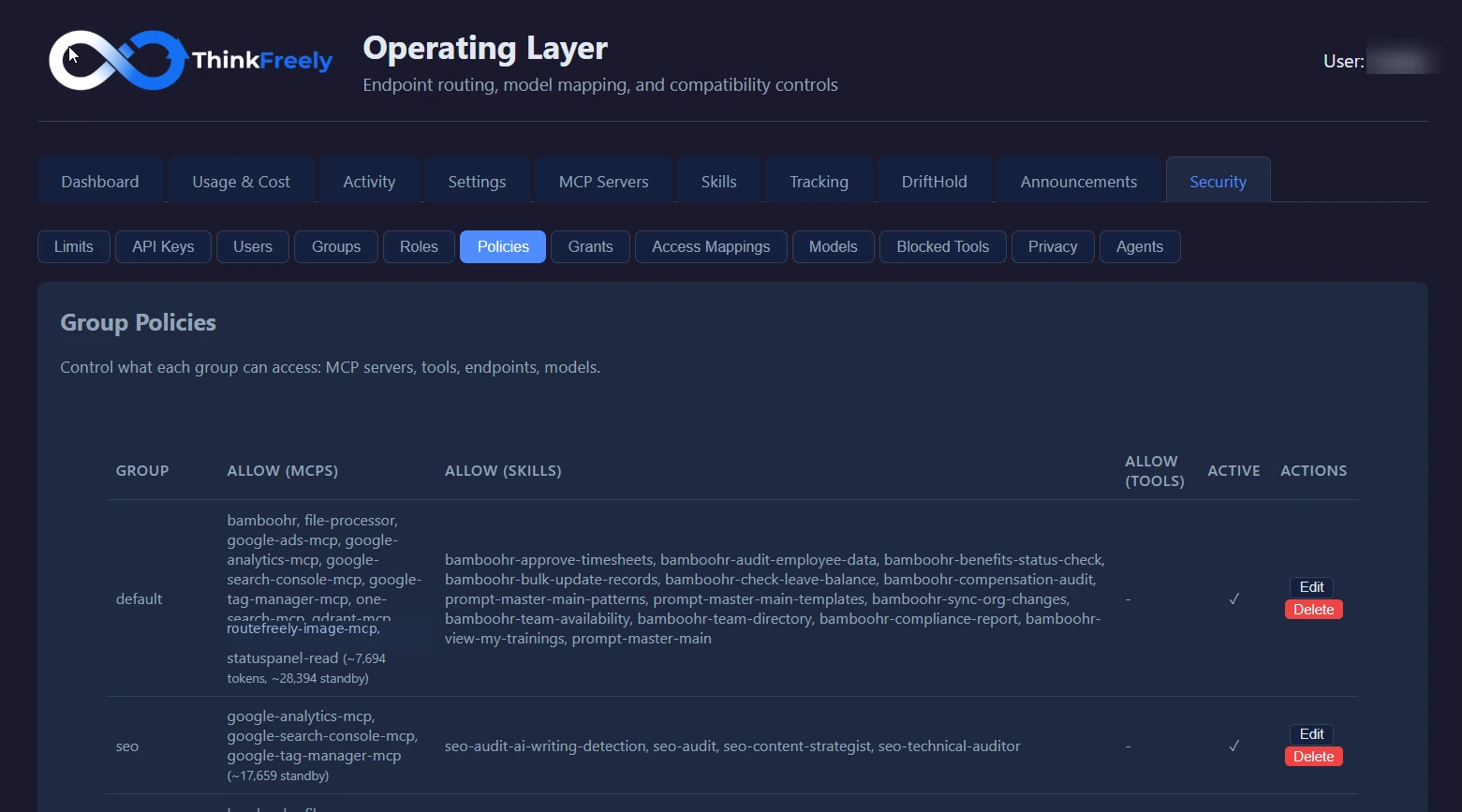
Policies attach to groups, not individuals
Group policies let you design access once and apply it consistently. This is the layer where governance design becomes configuration.
Assign ownership
Every control needs an owner. Name who approves models, who approves tools, who manages access, and who reviews incidents. Governance without owners drifts into exceptions granted quietly.
Approved path first
Give people a usable approved route before closing the unapproved ones. Adoption follows the easier path.
Exceptions in the open
Log and review exceptions rather than granting them silently. Governance that hides its exceptions is not governance.
Review against reality
Policy written before a pilot is a guess. After real usage, revisit which use cases are approved, restricted, or not ready, and adjust. The point is a living operating model, not a static document.
What we do not claim
We do not claim governance removes all risk or fits every regulation. Discuss regulatory specifics with appropriate professionals. We help design practical controls across models, tools, and workflows.
Operating checks for governance design
Key operating checks:
which use cases are approved, restricted, or not ready
who owns model, tool, and access approval
where human review remains required
what usage signals should trigger review
how the approved path stays easier than the workaround
Governance is how AI scales without losing control.