
AI ROUTING AND CONTROL LAYER
Route AI work by cost, privacy, capability, and policy.
RouteFreely is the AI routing and control layer inside the ThinkFreely ecosystem. It helps organizations direct AI work across approved models, providers, tools, privacy boundaries, and usage policies without tying every workflow to one vendor path.
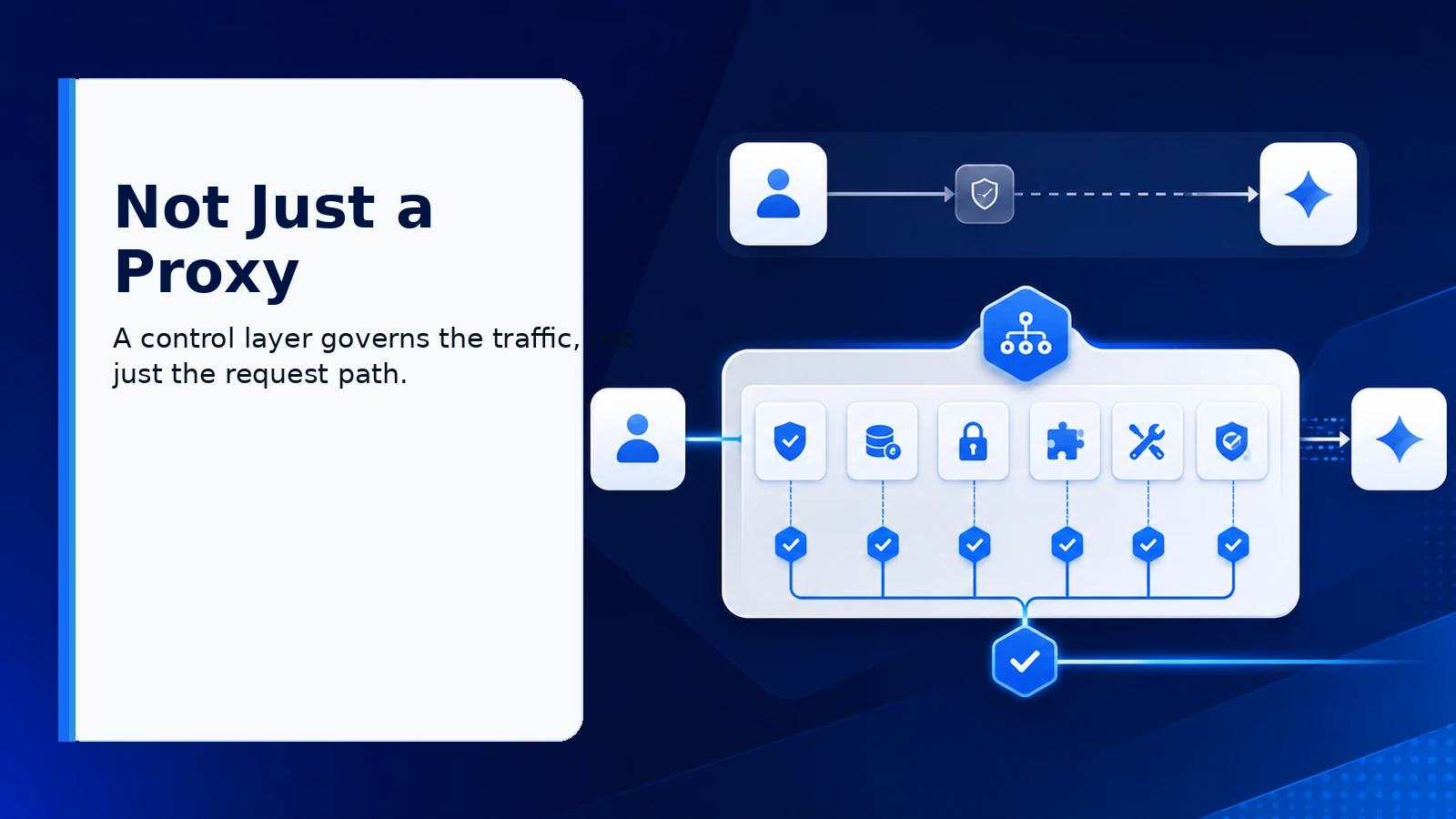
A normal proxy forwards requests. RouteFreely is designed to govern the traffic.

Not just a proxy
Many AI gateways solve the first problem: sending requests to a model. RouteFreely is built around the bigger operating problem: deciding where the request should go, whether the user is allowed to send it, how much it may cost, which tools may be used, and whether the work belongs in a local, private, or external environment.
That difference matters once AI usage spreads beyond experimentation. A company may have marketing prompts, legal reviews, sales drafts, developer tools, internal knowledge workflows, file analysis, customer support tasks, and automated agents all competing for model access. Without routing discipline, everything tends to drift toward the easiest default.
RouteFreely helps replace that default with policy-aware choice.
Core routing dimensions
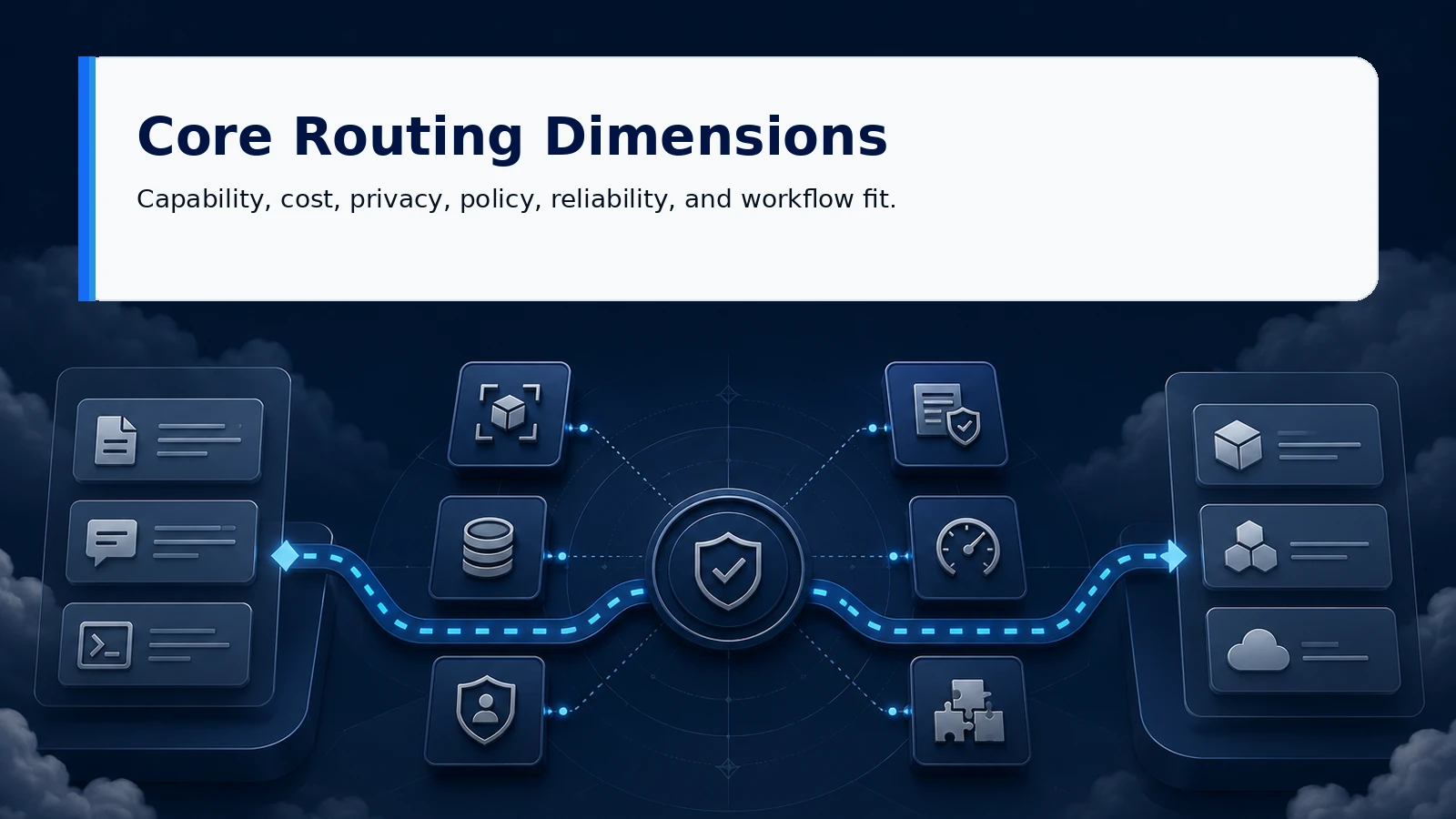
RouteFreely is designed to support routing decisions across several dimensions:
- Capability: Does the task require reasoning, tool calling, image understanding, embeddings, audio, long context, or structured output?
- Cost: Does the work justify a premium model, or can it use a lower-cost approved option?
- Privacy: Does the prompt contain sensitive, confidential, regulated, or internal-only material?
- Policy: Is this user, group, key, or workflow allowed to access this model or tool?
- Reliability: Is the preferred backend healthy, or should the request fail over to an alternative?
- Workflow fit: Is the request part of a governed skill, project, MCP tool flow, or application integration?
The goal is not automatic complexity. The goal is routing that matches the business reality of the work.
Model and provider flexibility
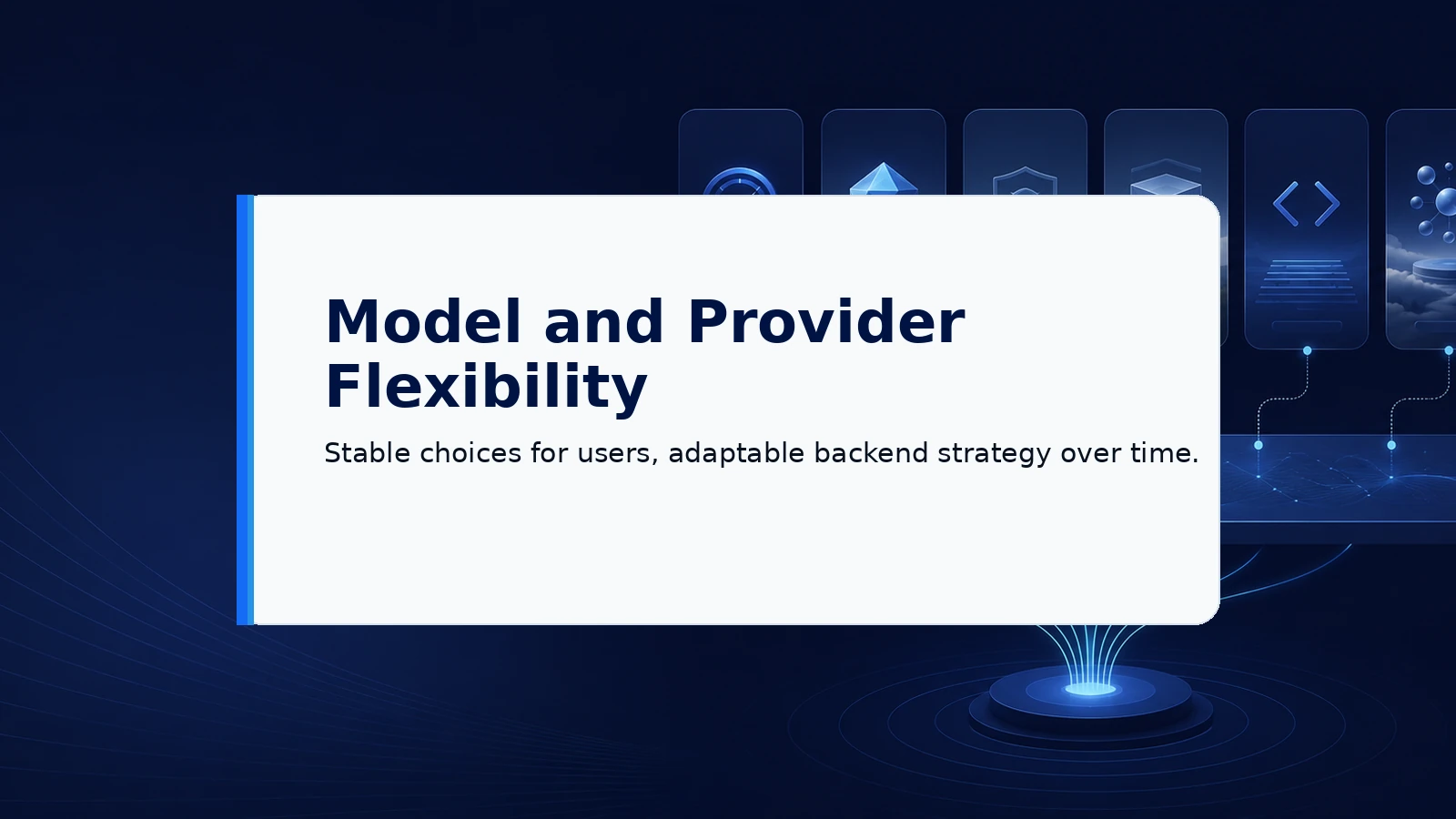
RouteFreely supports the product strategy of model independence. Organizations should be able to work across frontier providers, hosted inference, local models, private deployments, and specialized models where appropriate.
In practice, that means administrators can expose stable model choices to users or applications while changing the backend strategy over time. A virtual model might represent “approved-marketing-draft,” “private-legal-analysis,” or “low-cost-summary.” Behind that stable name, RouteFreely can direct traffic based on policy, availability, provider configuration, or future routing rules.
This reduces the cost of change. If the organization wants to test a new model, shift a workload, change a default, or add a fallback path, the workflow does not need to be rebuilt from scratch.
Provider endpoints stay under your control
Endpoint settings define where work can go before any request is sent. You change providers in configuration, not in application code.

Compatibility as a migration advantage
A major source of lock-in is not only the model. It is the API surface, client expectation, and integration pattern around the model.
RouteFreely’s direction includes compatibility across common AI protocol surfaces, including OpenAI-style, Anthropic-style, and Ollama-style usage patterns where supported and validated. This matters because developers often build tools around one provider before the company has decided whether that provider should become the long-term control point.
A governed gateway creates a better default. Applications can point to RouteFreely, and the organization can manage access, usage, routing, and provider strategy from one layer.
Cost and usage control
Cost-aware routing starts with visibility. RouteFreely is designed to track usage by user, key, model, endpoint, and activity pattern so administrators can see where AI spend is coming from.
From there, teams can apply controls such as:
- user-level and group-level limits
- API key limits
- model access restrictions
- hard caps for noncritical usage
- soft warnings for monitored usage
- rate controls for high-volume workflows
- routing rules that reserve premium models for premium work
The point is not to make AI cheap at the expense of quality. The point is to stop using the most expensive path by habit.
Privacy and data-boundary control
Not every request should be treated the same. A public marketing outline, an internal legal memo, a customer record, a source-code file, and an HR issue all carry different data-boundary expectations.
RouteFreely supports the product direction of privacy-aware routing: classify work before dispatch, apply policy, and route sensitive requests to approved environments when configured. In some cases, that may mean local-only handling. In other cases, it may mean redaction, anonymization, private model routing, or blocking the request until a human reviews it.
Be clear about the limits. Privacy-aware routing is not a guarantee of total privacy. It is an operating control that helps sensitive work follow clearer rules.
MCP and tool governance
When AI can use tools, access control becomes more important. A model that can call a CRM, search a document system, open a ticket, or query internal data should not receive blanket access to every tool for every user.
RouteFreely’s MCP governance direction includes server registration, tool discovery, permission management, identity propagation, activation modes, and activity visibility. This gives organizations a safer way to connect AI to real systems.
The goal is practical: make tool-connected AI useful without letting tool access become another shadow system.
Portable operating context
Routing alone is not enough. Organizations also need reusable operating context: instructions, skills, project rules, model behavior expectations, tool configurations, and governance choices that are not trapped inside one chat session or vendor workspace.
RouteFreely supports the broader ThinkFreely goal of making AI work more portable and governable. Where supported, skills, routing policies, context structures, and administrative choices can become reusable assets rather than one-off prompts.
Example workflow
A sales operations team wants AI assistance for proposal drafts. The first draft can use a lower-cost approved model. If the proposal includes confidential pricing, RouteFreely can direct it to a private route. If the user needs CRM data, only approved MCP tools are available. If the work exceeds the department’s monthly budget threshold, an administrator can receive a warning or enforce a limit.
That is the difference between AI access and AI operating control.
What a buyer should inspect
- Which providers and local backends are approved today?
- Which workloads deserve virtual models?
- Where should failover be allowed and where should it be blocked?
- Which usage limits should be hard stops versus warnings?
RouteFreely proof points to evaluate
A RouteFreely evaluation should look for concrete operating controls. Useful proof points include virtual models, model access control, inbound API key management, OpenAI-style compatibility where supported, Anthropic and Ollama compatibility where validated, usage and cost tracking, hard and soft limits, rate controls, MCP server management, tool activation rules, health checks, failover concepts, request tracking, and admin visibility.
Those details matter because RouteFreely should not be understood as a simple pass-through proxy. The strategic value is the control plane: routing, policy, cost, privacy, access, compatibility, tools, skills, and observability working together.
Instruction consistency with DriftHold
Long, multi-step, and failover-prone workflows tend to drift. Instructions get diluted, retries lose context, and behavior wanders. DriftHold is designed to hold authoritative instructions as structured, versioned, permissioned blocks rather than fragile prompt text.
Because instruction state is separated from the final rendered prompt, RouteFreely can render the same intent for different providers. That keeps behavior more consistent across long conversations, retries, and failover, and it makes how the AI was instructed auditable. DriftHold is the capability. Drift Control is the outcome it delivers: less drift, stronger instruction consistency, and more reliable behavior. Capability-aware routing complements it by sending each request to a model that can actually perform the task.
Operating checks for spend control
Key operating checks:
- which workflows are driving spend
- which requests justify premium reasoning
- where lower-cost approved routes are sufficient
- how budgets, caps, and exceptions should be reviewed
- whether spend is connected to business value rather than model habit