
INTEGRATIONS
Integrations: Connected Where Your Operation Already Lives
An operating layer is only useful if it meets your operation where it is: the models you want to use, the identity system you already run, the tools your work depends on, and the files your business produces. ThinkFreely connects at all four points, and governs the connection at each one. Integration without governance is just another leak. Here, the connection and the control arrive together.

Where ThinkFreely connects
-
Model providers
Route work across the AI models and providers your organization approves, through one policy layer. Provider choice stays a decision you keep making, not one you made once.
-
Identity
Sign in with Microsoft 365 or local login, with access administered centrally by user and group. Google SSO is planned.
-
MCP tool connections
Connect the tools your workflows need through the governed MCP registry, permissioned by user and group and visible to administrators.
-
Files
Bring images, PDFs, documents, spreadsheets, and audio into governed AI work. The formats your business runs on are working context, not attachments.
The principle behind the connections
Every integration on this page follows the same rule: the connection runs through the operating layer, so governance applies at the point of contact.
Models connect through routing policy, so where work goes is decided by cost, privacy, and capability rather than default. Identity connects through central administration, so access follows the organization’s structure. Tools connect through a registry, so what AI can reach is a managed inventory. Files connect through the governed workspace, so sensitive documents stop traveling ungoverned paths.
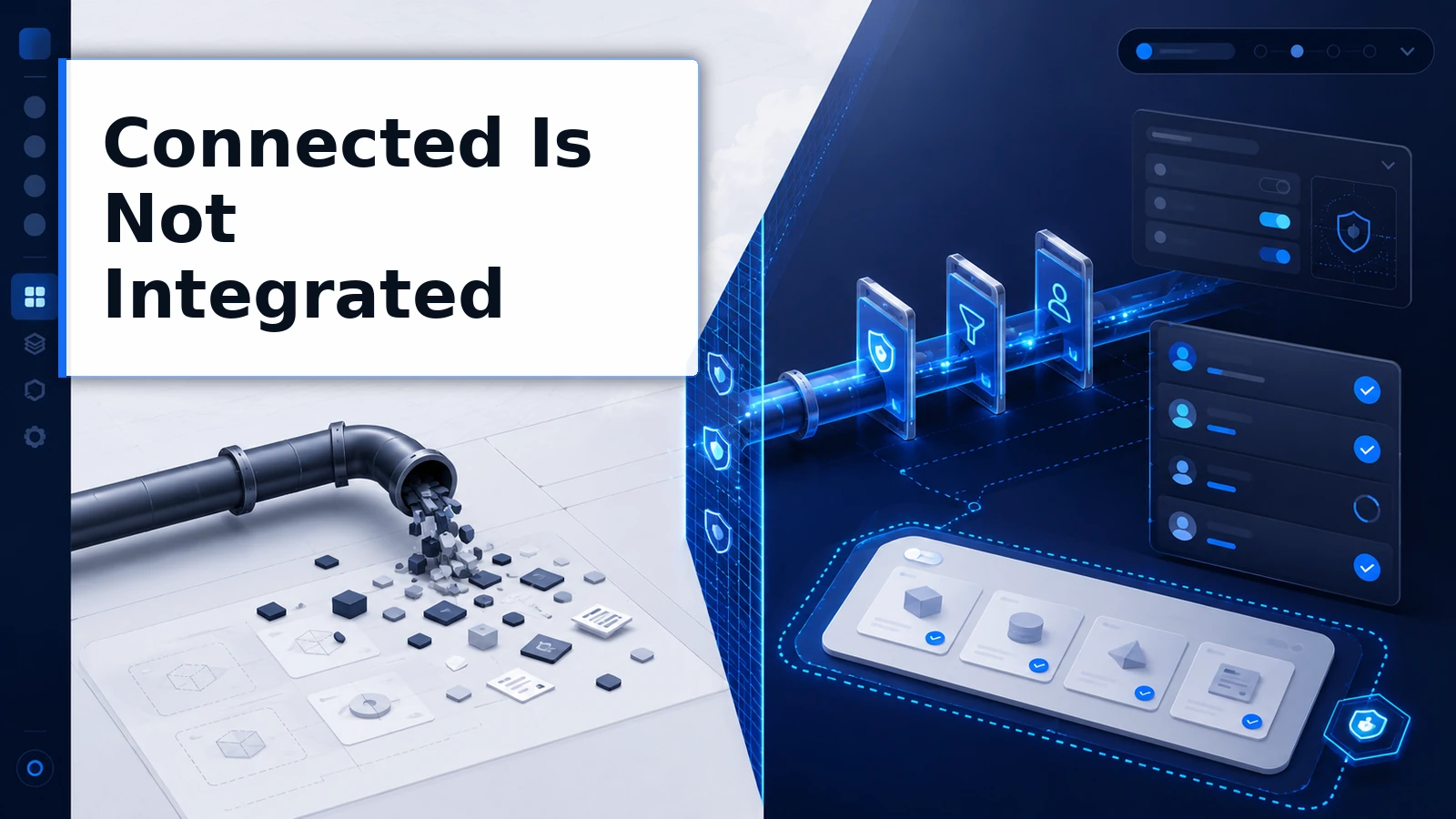
That is the difference between integrated and merely connected. Connected means the pipe exists. Integrated means the pipe answers to your rules.

What each connection point carries
Models are the connection with the most churn. Providers ship, deprecate, and reprice continuously, which is exactly why the connection runs through routing policy and virtual models: the landscape can move without dragging your workflows with it. Provider choice stays a live decision because the integration was built assuming change.
Identity is the connection with the most leverage. Every downstream control, who can use which models, run which skills, reach which tools, inherits its accuracy from sign-in. Microsoft 365 and local login are shipped today, and access administration is central from either path. Google SSO is planned, and we label it that way because roadmap is not product.
Tools are the connection with the most risk and the most value in the same place. MCP made connecting AI to systems cheap; the governed registry makes it accountable, with permissions by user and group and an inventory administrators can actually review.
Files are the connection closest to the work. Images, PDFs, documents, spreadsheets, and audio come in as governed context and leave as kept artifacts, which is what moves the sensitive documents off the ungoverned paths they travel today.
Evaluating integrations honestly
Integration pages are where vendors overclaim, so hold this one to the standard we set for it. Everything above is either shipped and stated plainly, or labeled as planned. Bring your actual environment to the demo: your identity setup, your tool inventory, the providers you use and the ones you are considering. Integration claims are cheap to make and fast to test, and we would rather you test them.
The four child pages below the cards carry the detail: what connects, how the governance applies at each point, and what is shipped versus planned, stated plainly on each. Read the ones your evaluation turns on, and bring the rest as questions. An operating layer is judged at its edges, and these pages are the edges.
Four connection points, one principle: your operation’s reach grows without your control shrinking. Connect the operation. Keep the control.