
CAPABILITIES
AI Provider Fallback: When a Provider Degrades, Work Keeps Moving
Every provider has bad days. AI provider fallback decides in advance what happens on yours: health checks catch degradation, and work reroutes along approved paths instead of stopping with the outage.

What AI provider fallback means
AI provider fallback is the automatic rerouting of AI work to an alternate model or provider when the preferred one is unavailable, degraded, or failing, according to rules defined in advance.
It is the AI equivalent of a discipline operations teams already know: single points of failure get failover paths. The difference is that in most AI deployments, the single point of failure is the entire operation’s default model, and nobody has written down plan B.
Your AI dependency is now an operational dependency
When AI was an experiment, an outage was an inconvenience. Once AI runs inside customer support, document processing, and daily production work, a provider incident is an operational incident.
The exposure compounds quietly. Teams build on one provider because it works. Volume grows. Then a degraded API at a bad hour stalls every workflow at once, and the postmortem discovers there was never an alternate path, because the architecture assumed the default would always answer.
Provider incidents are not hypothetical. Every major provider has them: outages, elevated error rates, latency spikes, capacity throttling. The question is not whether your provider will degrade. It is what your work does when it happens.
The mechanics: detect, decide, reroute
LLM failover has three moving parts, and each one is a policy decision, not just a feature.
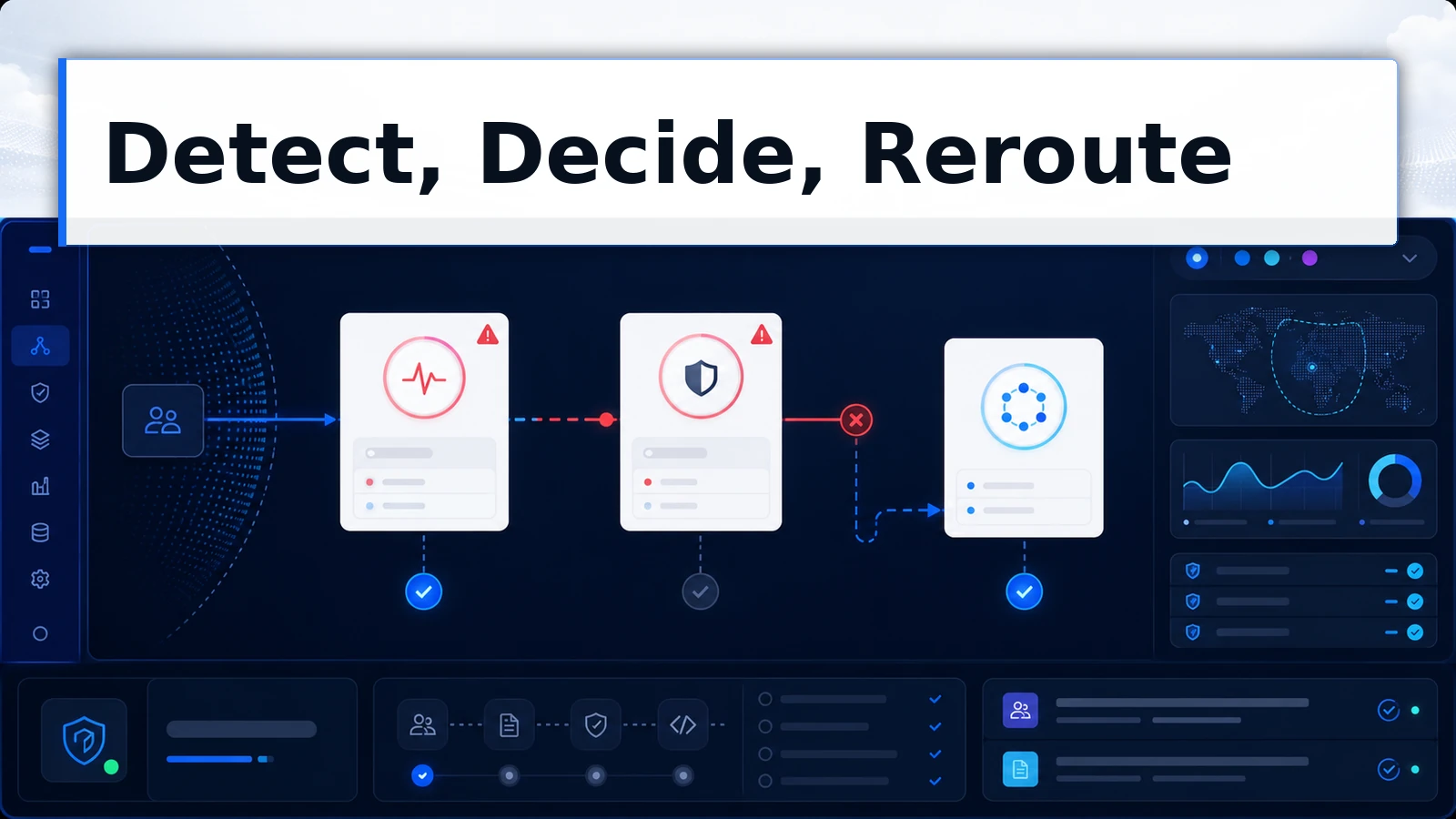
Detection. Health checks and error signals establish whether a backend is healthy, degraded, or down. Detection thresholds matter: too sensitive and you flap between providers, too tolerant and users feel the outage before the system does.
Decision. Circuit breakers stop sending work to a failing backend rather than piling retries onto it, and they govern when to probe it again. Retry rules distinguish a transient blip, worth one more attempt, from a real failure, worth rerouting.
Rerouting. Alternate-provider routing dispatches work to the approved fallback path. Approved is the key word: the fallback destination must still satisfy your cost, privacy, and policy rules, or the outage plan becomes a compliance incident.
How RouteFreely implements fallback
Fallback is a shipped RouteFreely capability, built into the routing layer where dispatch decisions already live.
Health checks monitor backend condition. Circuit breakers isolate failing providers and control recovery probing. Retry behavior handles transient errors without hammering a struggling endpoint. And alternate-provider routing sends work along the fallback paths your policy defines, so the destination in a bad hour is still one your organization approved in a calm one.
Because fallback runs inside the same policy engine as normal routing, the alternate path inherits your rules. Privacy-restricted work fails over only to environments cleared for its classification. Cost policy still applies. Fallback changes the backend, not the boundaries.
One thing we will not promise: uninterrupted uptime. No routing layer can make a failing provider healthy, and simultaneous multi-provider incidents, while rare, happen. What fallback provides is the prepared alternative: work continues along approved paths whenever an approved path is available.
What ships in the failover stack
-
Health checks
Backend condition is monitored continuously, so degradation is detected by the system rather than reported by frustrated users.
-
Circuit breakers
Failing providers are isolated instead of retried into the ground, with controlled probing to detect recovery and restore normal routing.
-
Retry rules
Transient errors get measured retries while genuine failures reroute promptly, balancing persistence against latency users actually feel.
-
Alternate-provider routing
Work reroutes to approved fallback backends defined in policy, so continuity never depends on improvising a destination mid-incident.
-
Policy-consistent failover
Fallback paths inherit your privacy, cost, and access rules, keeping the outage response inside the same boundaries as normal operation.
What fallback changes for the business
-
Incidents become degradations
A provider outage shifts from “AI is down” to “work is running on the alternate path”, which is the difference between an incident and a footnote.
-
Continuity you can state
Operations and leadership get a concrete answer to “what happens if the provider fails”, backed by configured paths rather than optimism.
-
Independence in practice
A working fallback path is model independence made operational: your ability to run on more than one provider is exercised, not theoretical.

Deciding your fallback policy
Questions that turn failover from a feature into a plan:
- Which workflows are operationally critical, and which can simply wait out an outage?
- For each critical workflow, which alternate backends are approved for its data classification and quality bar?
- How much output variation between primary and fallback models is acceptable, and who validated it?
- What latency or error thresholds should trigger rerouting, and who tunes them?
- How will you know fallback occurred, and who reviews those events?
Here is how two operations put fallback to work.
A customer service operation defines fallback for its triage workflow: if the primary backend degrades, requests reroute to an approved alternate tier, accepting slightly different summary style in exchange for continuity. Escalation drafting, which is quality-sensitive, is configured to queue briefly before failing over.
A logistics team runs shipment-document extraction around the clock. Its fallback path routes to a second approved provider with validated extraction quality, because a stalled document pipeline stops trucks, and “wait for the provider” is not a plan the dock accepts.
The evidence
-
Shipped in RouteFreely
All four failover mechanisms, health checks, circuit breakers, retry, and alternate-provider routing, ship in RouteFreely today.
-
Inside the policy engine
Failover executes within the same routing policy as normal dispatch, so alternate paths respect privacy, cost, and access rules automatically.
-
Observable failover
Rerouted traffic is visible in usage records, so fallback events can be reviewed rather than discovered by accident.
Where fallback has limits
Fallback needs somewhere to fall. If policy approves only one backend for a workflow’s data classification, there is no alternate path, and the honest fix is approving a second environment, not blaming the router.
Models also differ. A fallback backend produces its own style and judgment, and quality-sensitive workflows should validate the alternate path before the incident, not during it.
And fallback does not promise uninterrupted operation. It converts many outages into non-events and shortens the rest, but simultaneous failures and capacity crunches exist. Treat fallback as strong mitigation inside a continuity plan, not as a guarantee that replaces one.
Frequently asked questions
What is the difference between retries and fallback?
Retries re-attempt the same backend, appropriate for transient blips. Fallback changes the destination when the backend is genuinely degraded or down.
A sound policy uses both in sequence: measured retries first, then a circuit breaker isolates the failing provider and work reroutes to the approved alternate. Retries buy seconds. Fallback buys continuity.
Does fallback compromise our data boundaries?
Not in RouteFreely, because failover runs inside the same policy engine as normal routing. Work only reroutes to backends approved for its data classification. If no approved alternate exists, the work does not silently escape its boundary; that gap is surfaced as a policy decision for you to make deliberately.
Will users notice when fallback happens?
Sometimes. An alternate model may respond with different style or pacing, and quality-sensitive workflows should be validated on their fallback path in advance. Operationally, the difference users notice most is the one fallback prevents: nothing responding at all.
How does fallback relate to model independence?
Fallback is model independence exercised daily. An organization that can genuinely run critical work on more than one provider has proven its independence in the most practical way possible. It also compounds: the same routing flexibility that survives an outage is what makes deliberate provider changes routine.
How should fallback paths be tested?
Deliberately and periodically, not just configured and trusted. Route a controlled sample of real workload down the fallback path on a normal day, compare output quality against the primary, and confirm the records show what routed where. A fallback path exercised quarterly is a plan. One configured eighteen months ago and never touched is a hope with a settings page.
Decide now, not mid-incident
The worst time to design a fallback path is while the primary one is down.
Define the alternates, validate them, and let the routing layer do the rest. When your provider has a bad day, your operation should have an ordinary one.