
USE CASE
AI model switching should be your decision, not your vendor's.
Cost changes. A better model ships. A model stops honoring your rules. Each one is a reason to switch, and each one is a decision your organization should be able to make in an afternoon.
Most organizations cannot. AI model switching has become a project because the workflow, the prompts, and the context all live inside the model they started with.
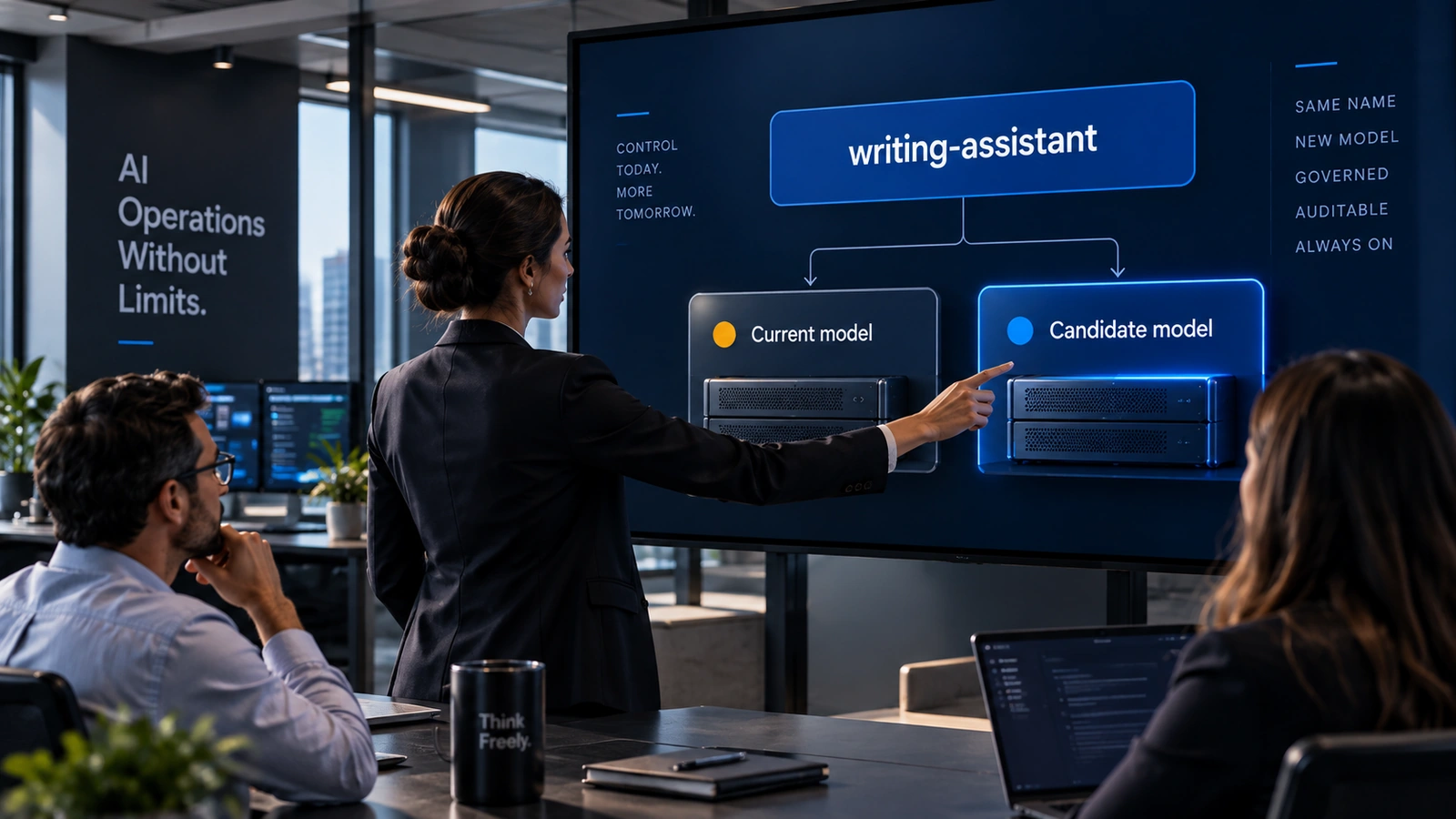
Why organizations stay on the wrong model
Nobody chooses to keep paying for a model that no longer fits. They keep paying because switching costs more than staying.
The costs are rarely on the invoice. Integrations are hardwired to one provider’s API. Prompts have been tuned to one model’s habits. Project files, instructions, and conversation history sit inside one vendor’s workspace. Nobody can say which workflows depend on which model, so nobody can say what a switch would break.
When switching means a rewrite, the switch never happens. The model becomes the foundation by default, and the organization inherits a single-provider strategy it never decided on.
The same switch works in both directions
The public conversation about an AI kill switch is about someone else deciding your model is done. That matters, and we cover how to keep approved work running when a model is taken away separately.
The more common case is quieter. You decide the model is done.
- Cost. The price per token rises, or usage grows past what the work justifies.
- Fit. A different model is better suited to the task, or a new release makes the current one the second-best choice.
- Governance. The model is not following the organization’s instructions, or it is no longer approved for the data it is handling.
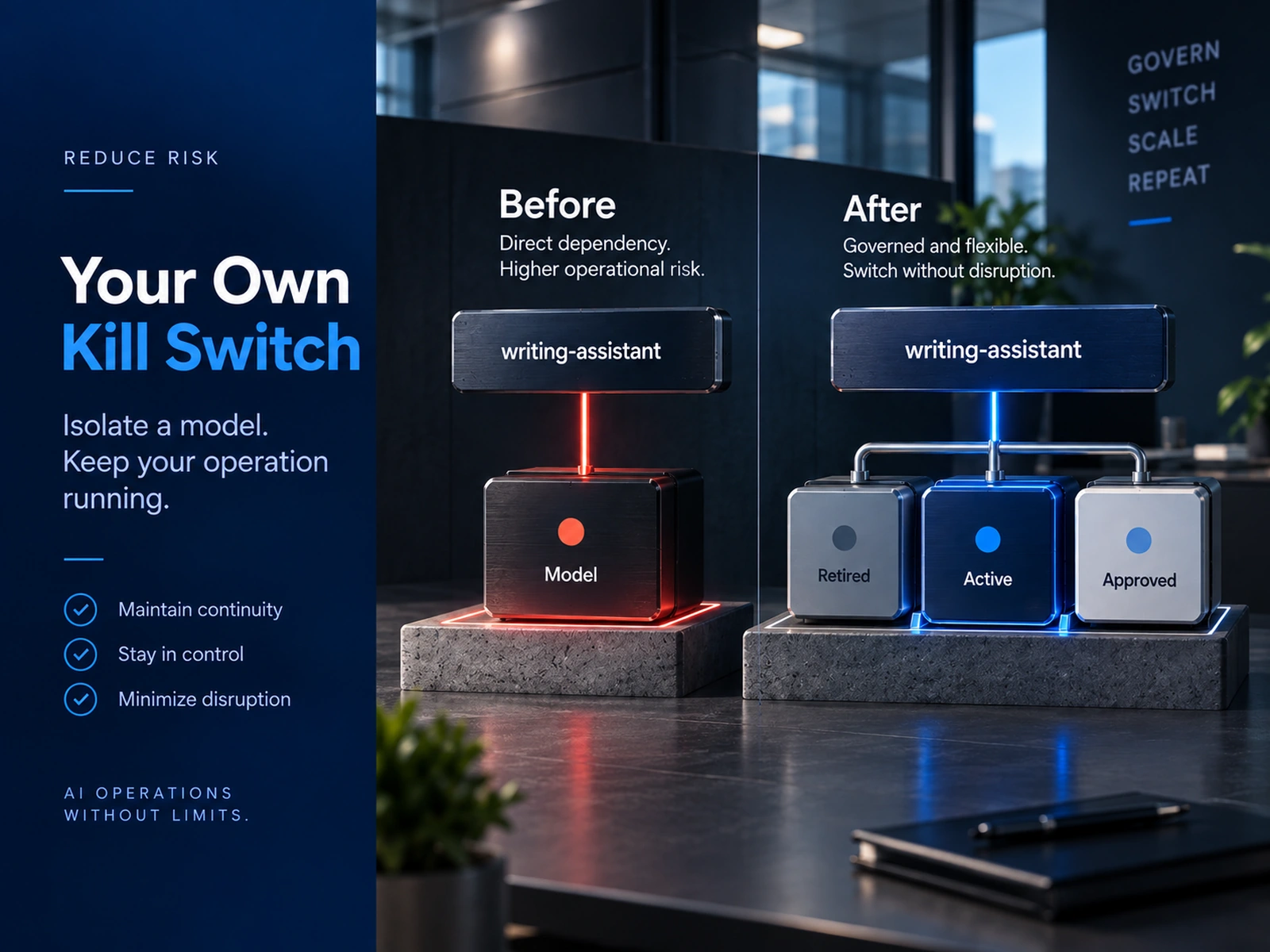
Each of these is a reason to retire a model from a workflow. AI model switching is the organization’s own kill switch, and it should be as controlled as the one regulators are debating.
They can switch it off. You can switch over.
The Second Switch in sixty seconds. The same routing layer that lets you retire a model by choice keeps eligible work running when a model is taken away.
Virtual models turn the switch into a policy change
The mechanism that makes switching routine is a stable name.
In RouteFreely, administrators define virtual models: friendly, stable names that map to real backends. A virtual model such as company-writing-assistant can point at one provider today and a different one tomorrow. Users see the same name. Applications call the same endpoint. Nothing upstream changes.
That is the whole difference between a migration and a decision. When the model is a replaceable dependency behind a name your organization owns, switching it is an administrative action with an audit record, not a development sprint.
Applications written for one vendor’s API keep working, because RouteFreely presents OpenAI-style, Anthropic-style, and Ollama-style protocol surfaces against the whole approved catalog. Existing tools repoint once and gain the ability to change backends without being rewritten.

Compare before you commit
Switching a production workflow on a benchmark is a gamble. Switching on your own traffic is a decision.
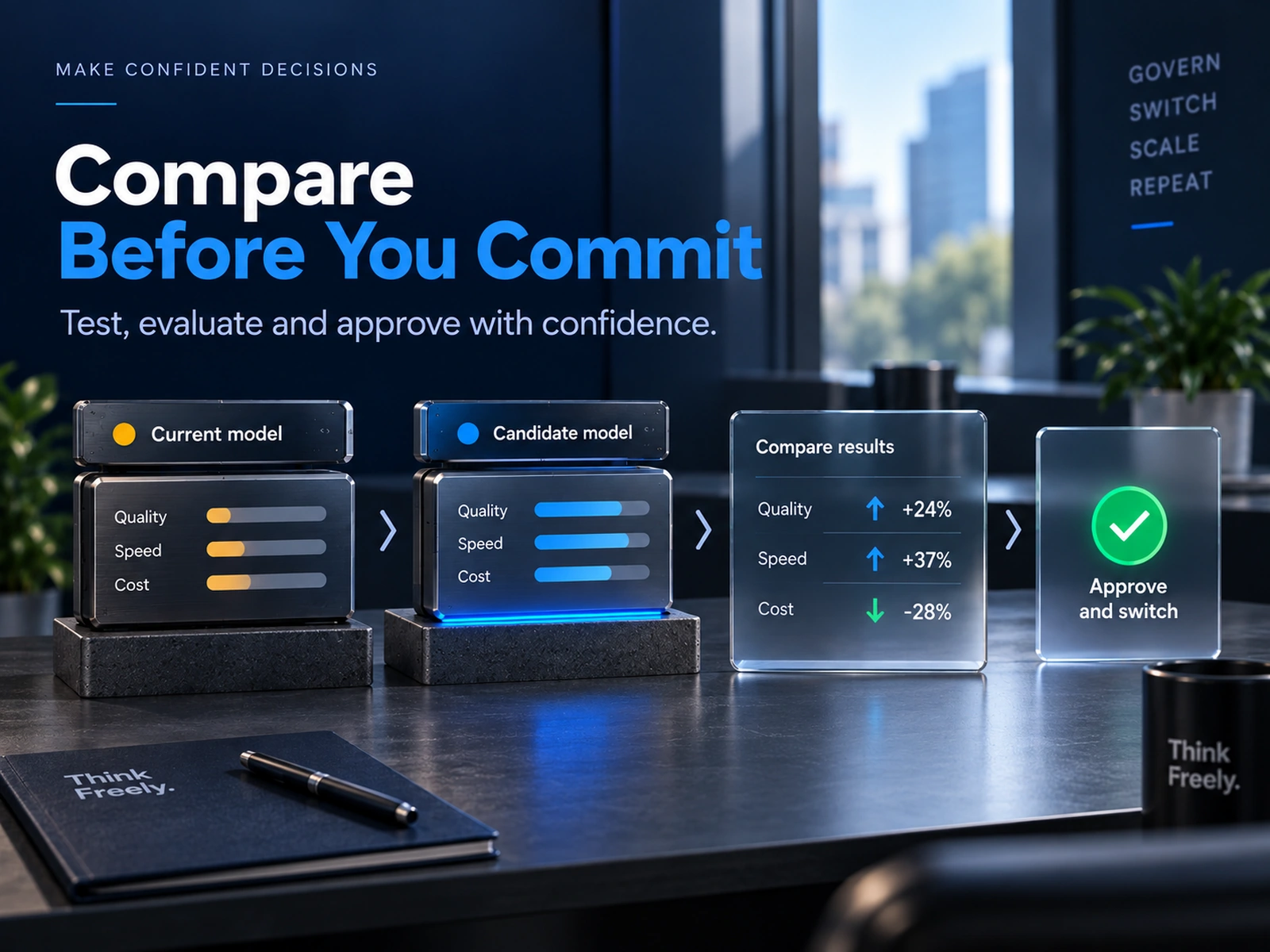
RouteFreely lets administrators map a virtual model to a new backend for a controlled comparison, review the results, and then complete the change or reverse it. Because every request is tracked with token counts, cost, and the routing decision that was made, the comparison is measured on the work your people actually do.
- run the candidate model for one group or one project first
- compare cost, speed, and output quality on real requests
- keep the current model as the fallback path during the trial
- complete the switch when the evidence supports it
Adoption becomes a policy decision the organization can defend, and reversal is the same action in the other direction.
Cost is a trigger, not a surprise
Cost-driven switching usually happens after the bill arrives. It should happen before.
RouteFreely scores each request and routes it to the right tier of model, so a one-line acknowledgement is not billed at frontier-model rates. Administrators set caps by dollar spend, token volume, or request count at global, key, group, and user scope. A hard cap rejects the request with a clear message and a reset time. A soft cap logs the overage and lets the work through.
When a model becomes too expensive for the routine portion of a workflow, routing policy moves that portion to an efficient tier permanently, while premium capacity stays reserved for the work that justifies it. That is a model switch driven by policy rather than by a budget review three months late.
Governance is a trigger too
A model that is not honoring your rules is a model you should be able to remove today.
ThinkFreely governance follows the operating path. Administrators can remove a model from a group’s approved catalog, deny it to an individual user even when the group allows it, or restrict which models an agent or a project may use. When a group runs in local-only privacy mode, requests are routed exclusively to models on infrastructure the organization controls, and if no eligible model exists the request is refused rather than quietly sent elsewhere.
The platform does not judge whether a model is following your instructions. It gives you the evidence to see it. Request reconstruction shows the difference between what a person typed and what the model actually received. Routing decisions are recorded with the tier and the reason attached. Instruction blocks locked through DriftHold render the same canonical rules to whichever model is selected, so a switch does not reopen the question of what the rules are.
Detection is your judgment. The switch is policy, and it takes minutes.
What moves with you, and what does not
We would rather tell you the limits than have you find them.
What stays above the model layer and moves with the switch:
- identity and group policy
- project files, instructions, and organizational knowledge
- Skills, which follow the Agent Skills open standard and export in standard form
- locked instruction blocks
- usage limits, tool permissions, and privacy modes
- the evidence trail
What does not transfer cleanly:
- provider-specific features that have no equivalent on the new model
- prompt tuning, which often needs adjustment when a workload moves between model families
- output behavior, which varies by model even under identical instructions
ThinkFreely helps improve portability and is designed to reduce unnecessary dependence. It does not promise frictionless migration, and a switch still deserves a review of the workflows it touches.
Model switching in practice
A finance team right-sizes its routine tier
Routine report explanations had been running on a premium model by habit. Usage tracking showed the spend, routing policy moved the routine tier to an efficient model, and the complex interpretation work kept its premium path under a monitored cap.
An engineering group adopts a new code model
A stronger code model shipped. Administrators mapped the engineering group’s virtual model to the new backend for two weeks, compared the request records, and completed the change. No developer changed a configuration.
A regulated team retires a model from sensitive work
A model approved for general drafting was being reached from a project handling personal data. The project’s model restrictions were tightened, the group’s privacy mode was set to local-only, and the model stayed available everywhere else it was appropriate.
Recommended next step
Start with the workflows where one model has quietly become the foundation. We can show you how RouteFreely makes the switch a decision your organization controls.
Operating checks for model switching
Key operating checks:
- which workflows are hardwired to one provider’s API today
- which virtual models exist, and which backends they map to
- what evidence you would use to decide a switch, and whether it is being collected now
- how a candidate model is trialed before it replaces a production path
- who is authorized to retire a model, and how that action is recorded
- which prompts and instructions would need review after a model family change