
CAPABILITIES
AI Model Routing: Use the Right AI for the Right Work
No single model is best at everything. AI model routing sends each request to the model or environment that fits its capability, cost, privacy, and policy requirements, without rebuilding your work around one provider.

What AI model routing means
AI model routing is the process of directing an AI request to the model or environment best suited to its capability, cost, privacy, latency, and policy requirements.
Instead of sending every task through one default model, a routing layer evaluates the work and dispatches it deliberately. Routine work can go to efficient models. Complex reasoning can go to stronger ones. Sensitive work can stay in approved environments.
The result is not just better economics. It is an AI operation that no longer depends on a single provider’s roadmap, pricing, or availability.
Why defaulting to one model creates problems
Most organizations did not choose a single-model strategy. They inherited one.
A team adopts the model that was easiest to start with. Workflows form around its behavior. Prompts get tuned to its quirks. Before long, every request, from a two-line summary to a confidential forecast, travels the same path at the same price through the same provider.
That default carries three costs. Premium capacity is spent on work that never needed it. Sensitive data flows to environments nobody explicitly approved. And the organization’s entire AI operation now moves at one vendor’s pace.
Multi-model routing exists to unwind that default without unwinding the work.
The criteria a routing decision should consider
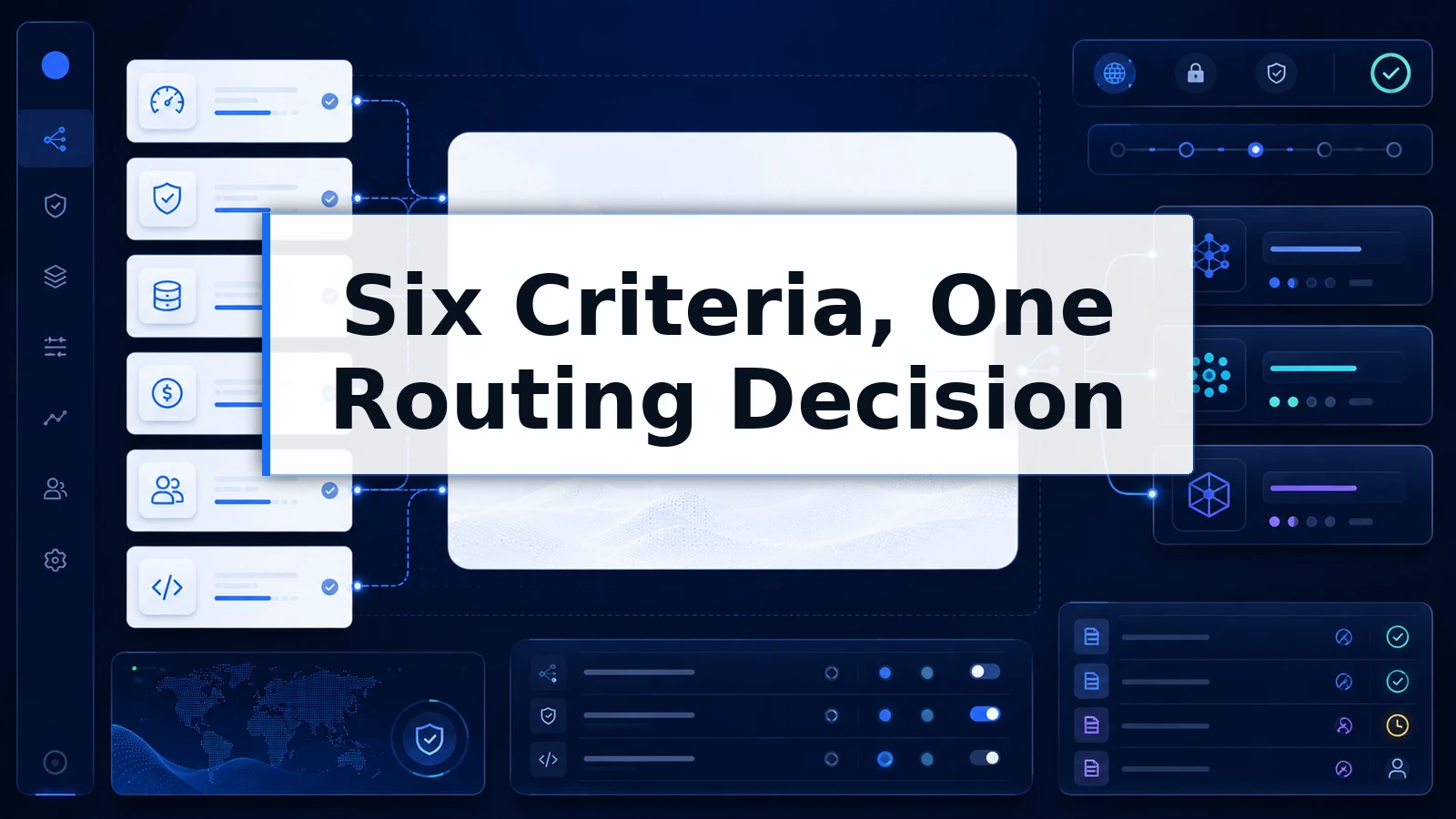
A useful routing decision weighs several dimensions at once.
| Routing criterion | Question answered |
|---|---|
| Capability | Can the model perform this task reliably? |
| Cost | Does the expected value justify the model expense? |
| Privacy | Is the environment approved for the data involved? |
| Latency | How quickly must the result come back? |
| Policy | Is this user, model, and workflow combination permitted? |
| Availability | What happens if the preferred model is down or degraded? |
No person can weigh all six for every request. That is the point of making routing a system rather than a habit. The criteria become policy, and policy runs on every request.
How RouteFreely dispatches work
RouteFreely is ThinkFreely’s routing and control layer. It sits between your teams and the models they use, and applies your routing policy to each request.
The pattern is straightforward. Work arrives with its context: who is asking, what workflow it belongs to, and what data classification applies. RouteFreely evaluates that against your policies for capability, cost, privacy, and permission, then dispatches to an approved model or environment. If the preferred backend is unavailable or degraded, fallback rules select an alternate path so work keeps moving.
Two qualifications matter. Routing does not make every model interchangeable; models behave differently, and some workflows need tuning when their backend changes.
And routing quality depends on the policies you define. RouteFreely enforces your judgment. It does not replace it.
The practical claim is this: RouteFreely supports routing by cost, privacy, capability, and policy, so provider choice becomes an operating decision you can revisit instead of an architecture you are stuck with.
The mechanisms behind LLM routing
-
Policy-based dispatch
Routing rules encode who can send what work to which models. Every request is evaluated against policy before dispatch, so the routing decision is systematic instead of left to individual habit.
-
Capability matching
Tasks are directed to models that fit their difficulty. Routine classification and drafting can use efficient models while complex reasoning is reserved for stronger tiers.
-
Cost-aware paths
Cost thresholds and premium-model controls keep expensive capacity for work that justifies it, helping reduce unnecessary premium usage without blocking it where it earns its price.
-
Privacy-aware boundaries
Data classification determines which environments a request may reach, so sensitive work is dispatched only to approved destinations under your data boundary policy.
-
Fallback and recovery
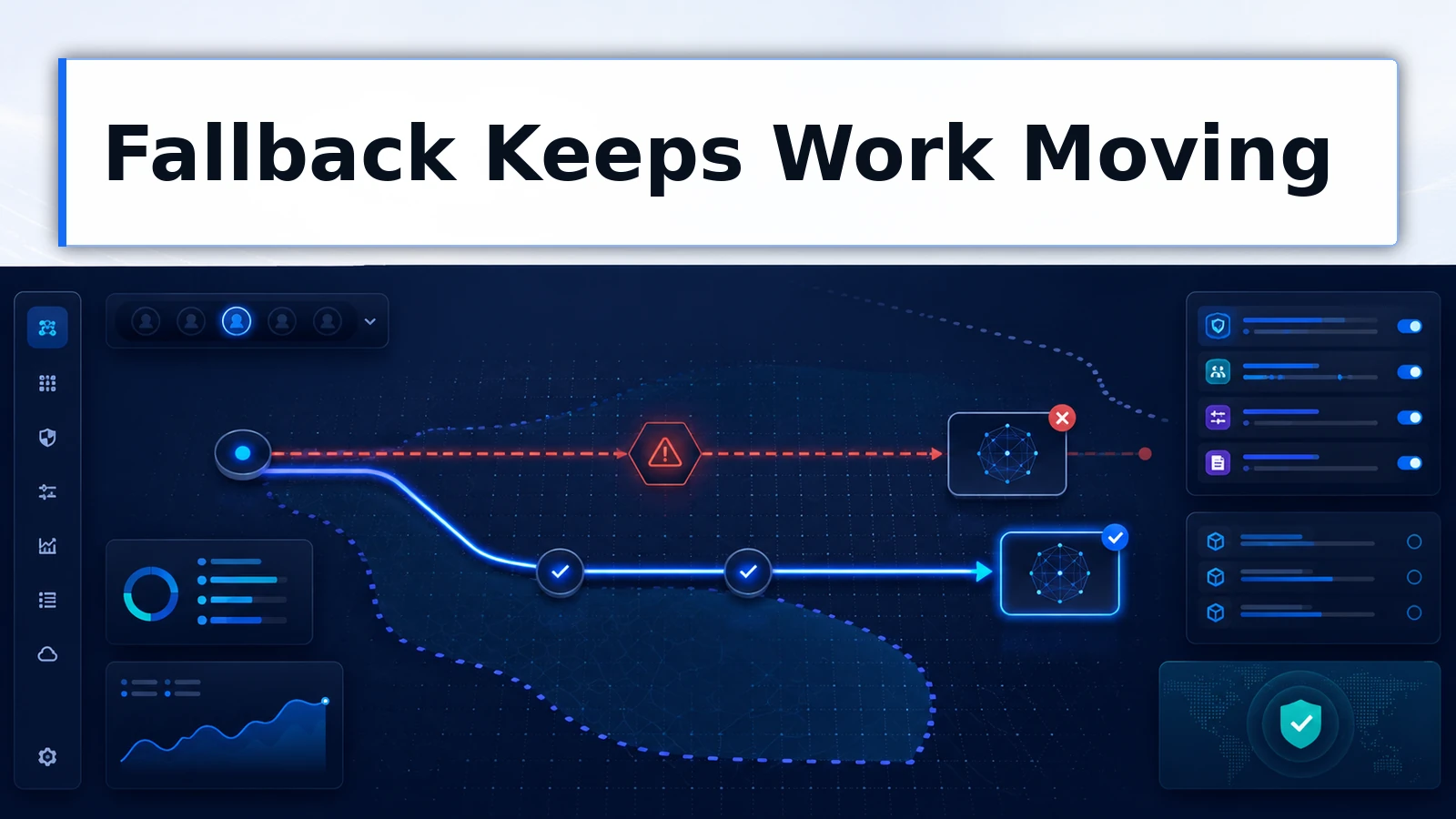
When a provider degrades or fails, alternate-provider routing and retry behavior keep work moving along approved paths instead of stopping with a single vendor’s outage.
-
Virtual model names
Teams address stable model names while the backend behind each name stays flexible, so workflows do not need rewiring every time the best available model changes.
What routing changes for the business
-
Spend matched to value
Routing aligns model cost with task value, which can reduce unnecessary premium-model usage while keeping strong models available where they matter.
-
Sensitive work stays bounded
Privacy-aware dispatch turns data-handling intentions into enforced paths, so where work goes is decided by policy rather than by whichever tool a user opened.
-
Provider choice preserved
Because workflows address a routing layer instead of one vendor’s endpoint, adopting a new model becomes a policy change rather than a migration project.
Routing decisions across the business
Routing proves its value in ordinary work, not just architecture diagrams.
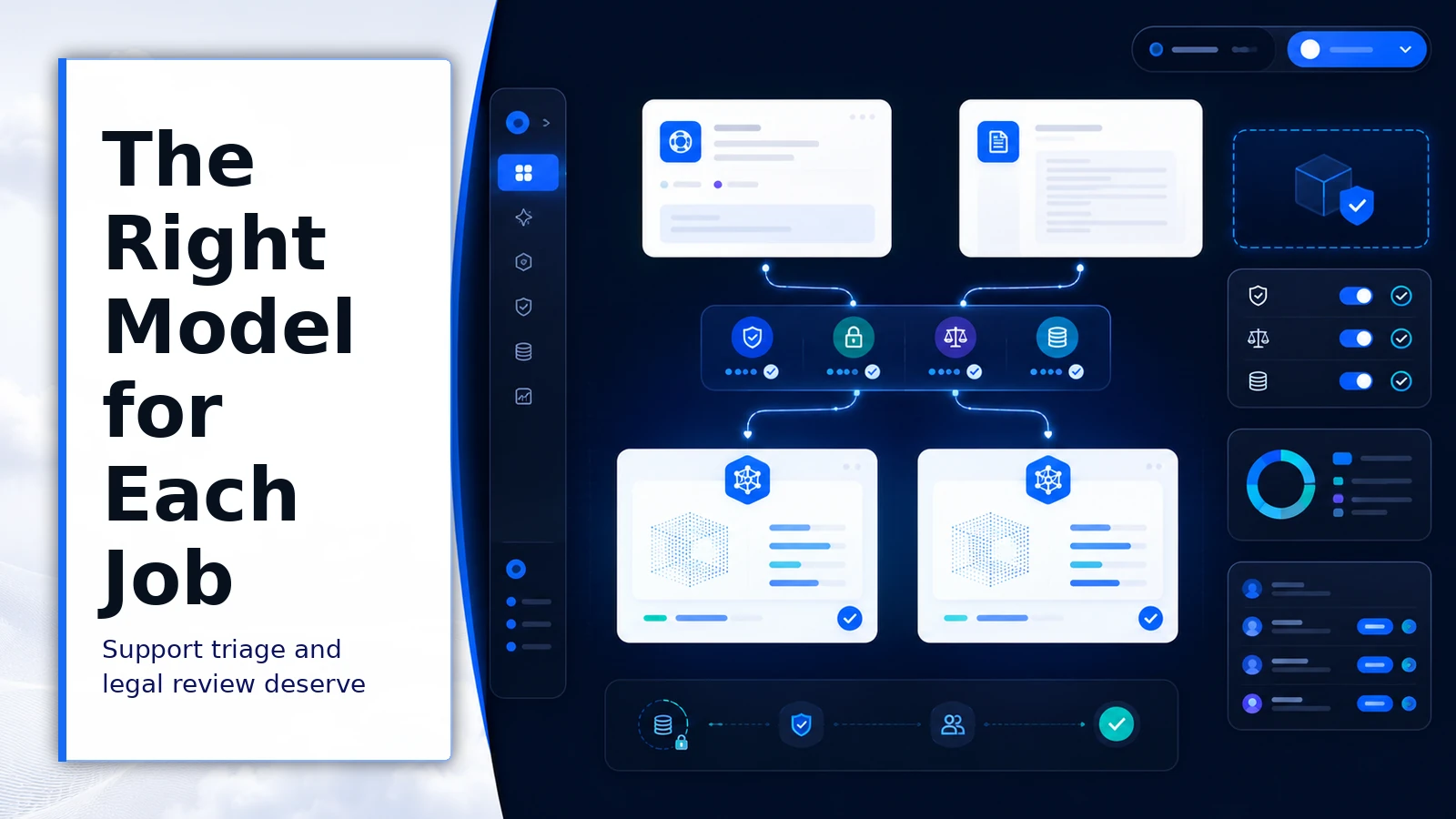
A finance team categorizes routine expense notes with a lower-cost approved model, while a quarter-end forecasting explanation routes to a stronger reasoning model. If the forecast touches confidential acquisition data, policy can require a private environment or prohibit external processing entirely.
A customer support operation runs thousands of triage requests a day through an efficient model, with automatic escalation of complex complaints to a premium tier. Volume work stays cheap. Hard cases get the capability they need.
An engineering group routes internal code review to an approved environment cleared for proprietary source, while public documentation drafts can use a general-purpose frontier model. Same team, different boundaries, one policy.
In each case the decision rests on task value, capability, and data sensitivity, not on a universal preference for the cheapest or the most powerful model.
What to evaluate before adopting model routing
- Which of your current workflows are tuned to one model’s behavior, and how deeply?
- What share of today’s requests genuinely needs premium capability?
- Which data classifications exist, and which environments are approved for each?
- Who should be allowed to change routing policy, and how are changes audited?
- What should happen, specifically, when your primary provider has a bad day?
If those questions have no owner, routing is the discipline that gives them one.
Shipped, not promised
-
Multi-criteria policy engine
RouteFreely evaluates capability, cost, privacy, and policy on each request, so dispatch reflects all relevant constraints rather than a single default.
-
Shipped fallback behavior
Health checks, retry, and alternate-provider routing are live RouteFreely capabilities, keeping work moving through provider degradation.
-
Usage visibility built in
Routed traffic is recorded by user, model, and workflow, giving administrators audit visibility into where work actually went and what it cost.
Where routing has limits
Routing is powerful, but it is not magic, and it is worth being precise about that.
Models are not interchangeable. A prompt tuned for one model may need adjustment on another, and some provider-specific features have no equivalent elsewhere. Routing preserves your ability to move work. It does not promise that every workflow moves without modification.
Routing also inherits the quality of its policies. Vague data classifications or unrealistic cost thresholds produce vague, unrealistic routing. The organizations that get the most from multi-model routing are the ones that treat policy definition as real operating work.
Frequently asked questions
What is the difference between AI model routing and load balancing?
Load balancing distributes identical work across identical backends for performance. AI model routing makes a qualitative decision: which model or environment should handle this specific request, given its difficulty, cost tolerance, data sensitivity, and the policies that apply. Routing may include load-style fallback, but its core job is matching work to the right destination, not spreading it evenly.
Does model routing mean always using the cheapest model?
No. Cost-aware routing matches spend to task value.
Routine, high-volume work often belongs on efficient models, and complex reasoning often justifies a premium tier. The failure mode routing prevents is paying premium prices by default for work that never needed premium capability. The right model for the work is sometimes the expensive one.
Can routed workflows switch to any model instantly?
No, and claims like that deserve skepticism. Routing makes switching a policy decision rather than a rebuild, which is a large practical difference. But models behave differently, and workflows sometimes need tuning when the backend changes. RouteFreely’s virtual models reduce the rewiring, not the need for judgment.
How does routing interact with AI governance?
Routing is where governance becomes enforcement. Access controls define who may use which models and tools. Data boundary policies define where classified work may go. Routing applies those decisions to every request and records the outcome, which is what makes AI governance auditable rather than aspirational.
Make model choice an operating decision
The question is not which model is winning this month. It is whether your AI operation can adapt when the winner changes.
AI model routing turns that adaptability into ordinary policy. Use the right AI for the right work, and keep the decision in your hands.
Related pages
-
Model Independence
Why model independence matters.
-
Cost Aware Routing
How cost-aware routing matches spend to task value.
-
Privacy Aware Routing
Routing sensitive work by data classification.
-
Virtual Models
Stable model names over changing backends.
-
Provider Fallback
How provider fallback keeps work moving.