
CAPABILITIES
AI Instruction Drift: Why Your Rules Erode and How to Lock Them
You wrote the rules once. Then a model update softened them, a long session buried them, and a different team pasted an older version. DriftHold locks your canonical instructions so they hold their shape across every model and session.

What AI instruction drift is
AI instruction drift is the gradual divergence between the instructions you intended your AI to follow and the instructions actually governing its behavior at any given moment.
Drift happens without anyone changing the rules. Long conversations dilute early instructions.
Model updates shift how the same wording is interpreted. Different models weight the same instruction differently. And copies of “the prompt” multiply across teams until nobody knows which version is canonical.
The result is an AI operation whose behavior slowly stops matching its policy, one session at a time.
How instruction drift actually forms
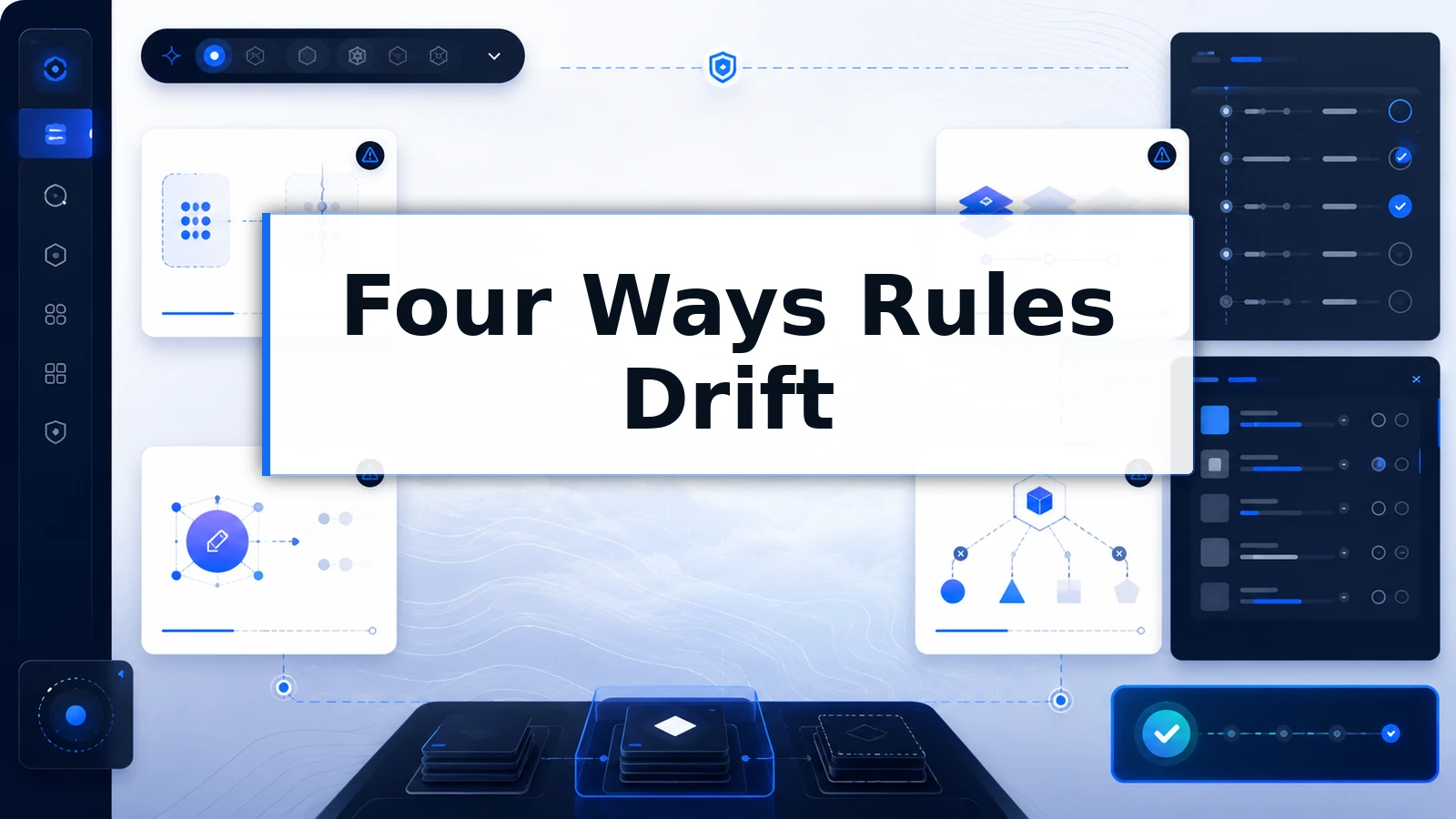
Drift is not one failure. It is four quiet ones compounding.
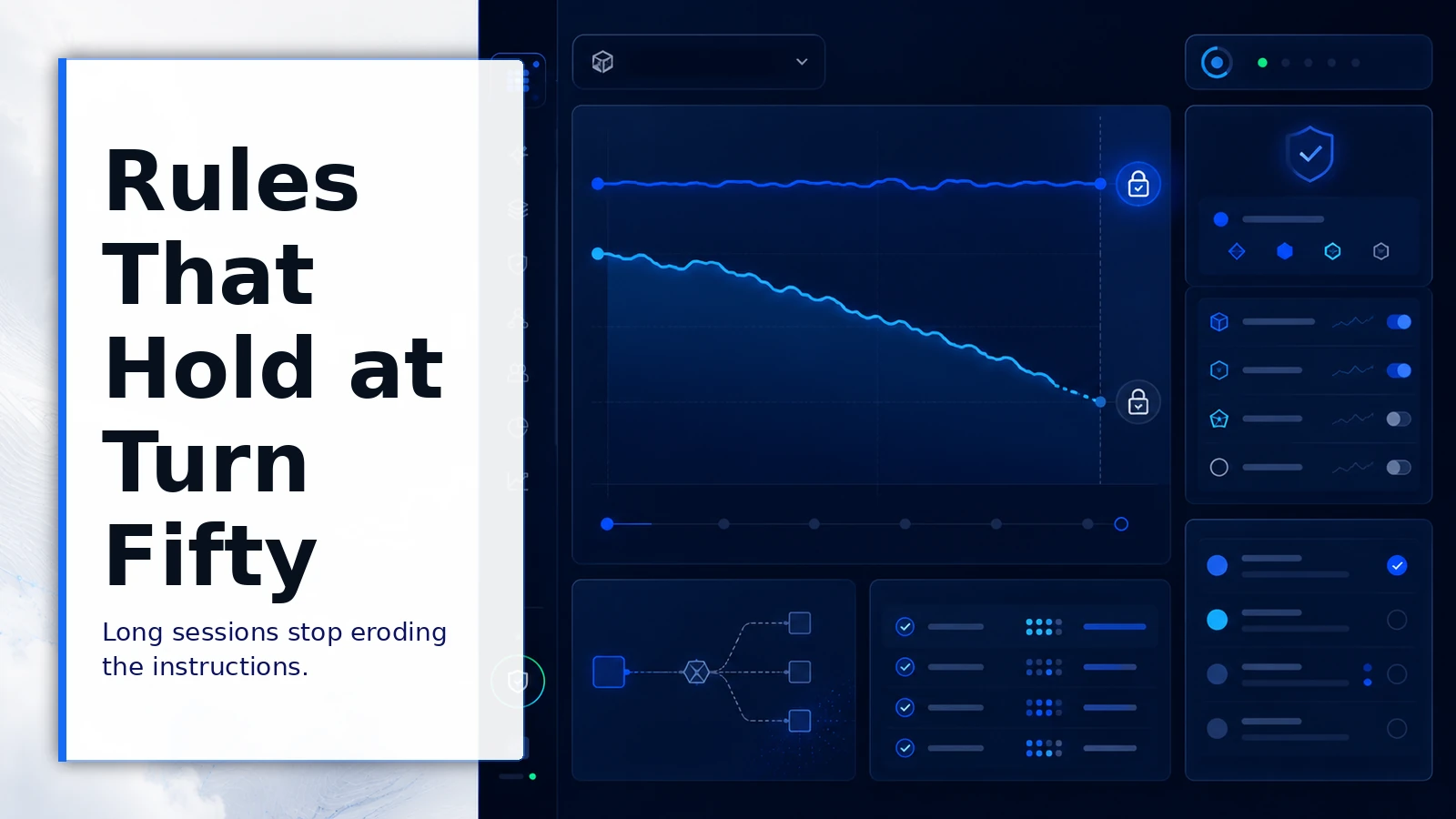
Session decay. In long working sessions, early instructions compete with an ever-growing context. Rules stated at the start carry less practical weight by hour three, and the output shows it.
Model change. Providers update models continuously. An instruction that produced consistent behavior last quarter can land differently after an update, with no notice and no diff.
Cross-model variance. The same wording is not the same instruction to different models. Move a workflow between backends and the rules travel in letter but not in effect.
Copy sprawl. Instructions get pasted, tweaked, and re-shared. Within months, five teams run five near-versions of the brand rules, each confident theirs is current.
Each failure is small. Together they explain why AI output that started on-policy ends up merely near it.
Why drift is a governance problem, not a prompt problem
The instinct is to fix drift with better prompt writing. That treats a structural problem as a wording problem.
Compliance language, brand rules, and workflow constraints are policy. Policy needs a canonical source, controlled distribution, and consistent enforcement. When those properties live in scattered prompt text, drift is not a risk. It is a schedule.
Instruction consistency, then, is a context governance question: where do the canonical rules live, who can change them, and what guarantees they arrive intact in every session on every model.
How DriftHold locks instructions in place
DriftHold is ThinkFreely’s shipped product for canonical instruction locking across models and sessions.
Instructions are captured as structured instruction blocks rather than loose prompt text. Each block is the canonical version of a rule set: brand voice, compliance constraints, workflow behavior, or whatever your operation depends on. Locked blocks are preserved and rendered consistently into every session that uses them, across models and across time, so the rules governing a conversation are the rules you actually published.
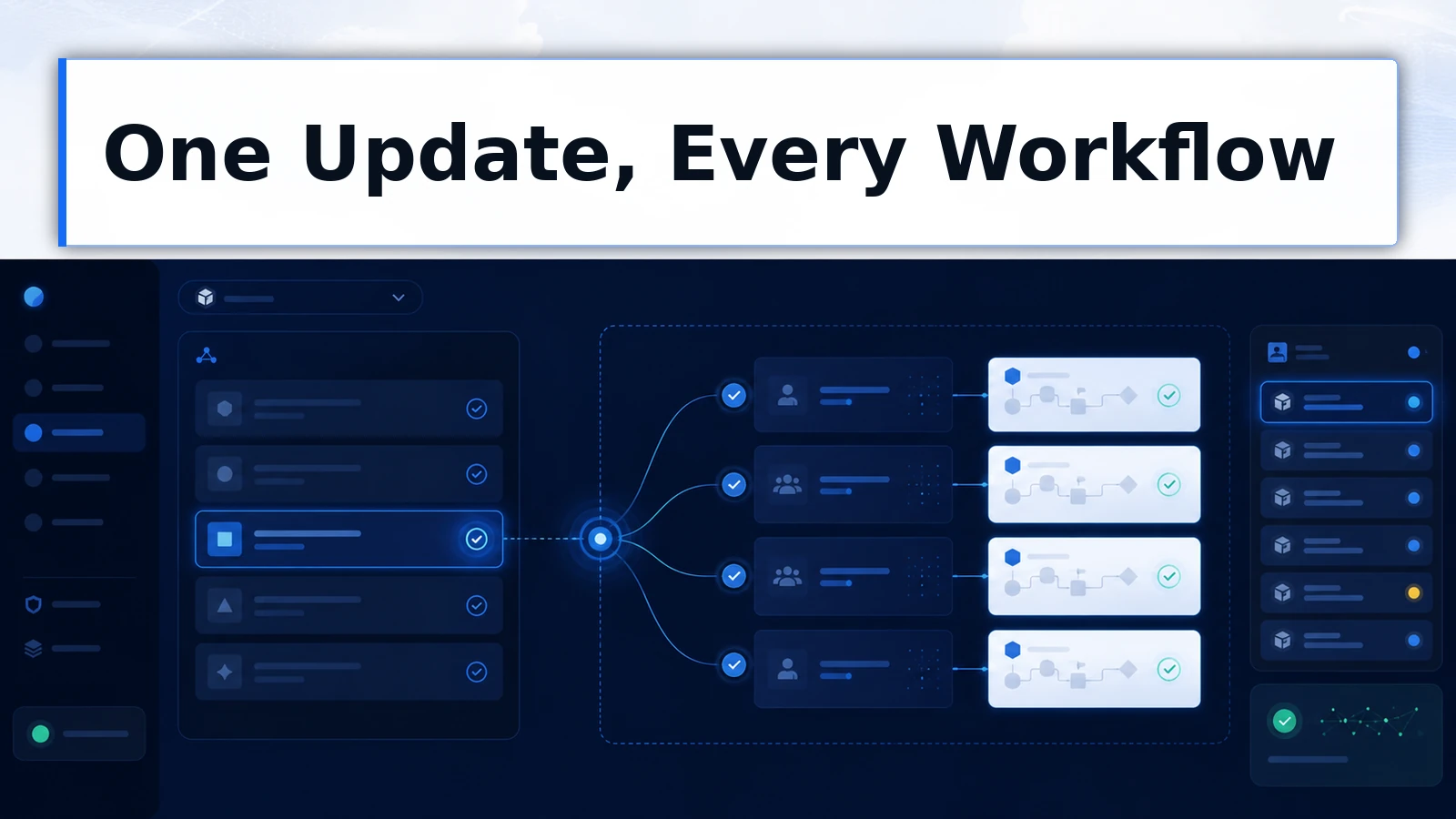
Because blocks are canonical, updates propagate from one place. Change the compliance language once, and every locked workflow carries the new version. No hunting through team folders for stale copies.
DriftHold does not make different models interpret identical rules identically; models retain their own behavior. What it guarantees is the input side: your instructions arrive intact, current, and in canonical form everywhere they apply. That is the controllable half of consistency, and it is the half most organizations have never controlled.
What DriftHold provides
-
Structured instruction blocks
Rules are captured as structured, canonical blocks instead of loose prompt text, giving each instruction set one authoritative source your organization controls.
-
Cross-model locking
Locked instructions are preserved and rendered consistently whichever model runs the work, so switching or routing backends does not quietly rewrite your rules.
-
Cross-session persistence
Canonical instructions hold across sessions rather than fading with context, so the rules in hour three are the rules from minute one.
-
Single-point updates
Editing the canonical block updates every workflow that uses it, replacing copy sprawl with controlled distribution of current rules.
-
Consistent rendering
Blocks are rendered into sessions in a consistent, structured form, so instruction delivery is predictable instead of dependent on who pasted what.
What locked instructions change for the business
-
Policy that stays policy
Compliance and brand rules keep their intended force in every session, because the canonical version is what runs, not whatever survived the copy chain.
-
Model changes without rule loss
Adopting a new model or absorbing a provider update no longer means rediscovering and re-tuning scattered instructions from memory.
-
One source of truth
Disputes about which prompt version is current disappear. The locked block is the answer, and its history is inspectable.
Where locked instructions matter most
Decision criteria for what to lock first:
- Which instructions carry legal or regulatory weight if they degrade?
- Which rules define customer-facing voice, where drift is publicly visible?
- Which workflows run across multiple models or teams, multiplying divergence?
- Which prompt sets have already forked into competing versions?
Watch it operate in two very different settings.
A legal and compliance team locks the disclosure language and review constraints that must accompany AI-assisted client communication. Whether the work routes to an efficient model or a premium one, the constraints arrive verbatim, and updating a regulatory phrase happens once, centrally.
A customer service organization locks tone, escalation, and prohibited-commitment rules for AI-drafted replies. Sessions run all day and agents rotate, but the rules do not decay with the shift, because they are rendered fresh into every session rather than surviving on context memory.
The proof behind the claim
-
Shipped and in production
DriftHold is a shipped ThinkFreely product, not a roadmap item. Canonical instruction locking across models and sessions is available today.
-
Canonical block architecture
Structured instruction blocks give every rule set one authoritative, updatable source, which is the structural fix copy sprawl cannot survive.
-
Works with routing
DriftHold operates above the model layer alongside RouteFreely, so locked rules travel with work wherever routing policy sends it.
What drift control does not do
DriftHold controls the instruction side of consistency. Model behavior remains the model’s. Two backends given identical canonical rules can still differ in style and judgment, and workflows that switch models may want tuning even with rules locked.
Locking also imposes discipline. Canonical blocks need owners, and edits become deliberate acts rather than casual tweaks. That is the point, but teams used to editing prompts freely will feel the difference.
Finally, drift control governs instructions, not knowledge. Stale facts in a knowledge source are a retrieval problem, and no instruction lock fixes them.
Frequently asked questions
What is the difference between instruction drift and model drift?
Model drift is the provider’s side: the model’s behavior changing across updates and versions. Instruction drift is your side: the rules you deliver diverging from canon through session decay, copy sprawl, and inconsistent delivery. You cannot control the provider’s updates. You can fully control whether your instructions arrive canonical and intact, which is what DriftHold does.
Does DriftHold work across different AI models?
Yes. Locking and rendering operate above the model layer, so canonical blocks are preserved and delivered consistently whichever backend runs the work, including work dispatched by RouteFreely. Models still interpret with their own behavior, but the instructions they receive are identical and current.
How is this different from just saving prompts in a document?
A document is a reference. DriftHold is enforcement. Saved prompts still get pasted, tweaked, and forked, and nothing guarantees a session actually carries the current version. Locked blocks are rendered into sessions directly from the canonical source, so distribution and delivery are controlled, not advisory.
What should we lock first?
Start where degradation costs the most: compliance and disclosure language, brand voice for customer-facing output, and constraints on high-volume workflows that run across models or teams. These are the rule sets where drift is either expensive or publicly visible, and where a canonical source pays back immediately.
Where should an organization start with drift control?
Start where instruction failure is most expensive: compliance language, brand claims rules, and the constraints attached to regulated output. Lock those canonically first, confirm they hold through your longest real working sessions, and expand from there. Drift control adopted around the highest-stakes rules pays for itself on the first incident that does not happen.
Rules that hold their shape
Your instructions are policy. Policy should not depend on which model ran, how long the session lasted, or who pasted which version.
Lock the canon once. Let it hold everywhere.
Request a demo or see DriftHold.