
CAPABILITIES
AI Usage Visibility: See Who Is Using AI, for What, and at What Cost
You cannot govern what you cannot see. AI usage visibility turns “we think people are using it a lot” into who, for what, through which models, and at what cost, answered from records instead of guesses.

What AI usage visibility means
AI usage visibility is the ability to see AI activity across the organization in attributable terms: which users and groups are using AI, for which workflows, through which models and endpoints, under which API keys, and at what cost.
It is the measurement layer of AI operating control. Access controls decide what may happen. Routing decides where work goes. Visibility shows what actually happened, which is the part every other discipline depends on.
Four questions most organizations cannot answer
Ask a leadership team about its AI operation and four questions usually go unanswered.
Who is using AI? Not seat counts. Actual usage: which teams have adopted it deeply, which barely touch it, and where the unexpected heavy users are.
For what? Which workflows and tasks consume the activity, and whether the usage matches the work the investment was meant to serve.
Through which models? Where the traffic actually goes: which tiers, which providers, which endpoints, and whether premium capacity is serving premium work.
At what cost? Spend attributed to users, groups, models, and workflows, instead of one aggregate invoice that explains nothing.
Without answers, everything downstream is guesswork: budgets defended with anecdotes, policies written blind, and value conversations that go nowhere because nobody can connect spend to work.
Visibility is where accountability starts
AI accountability has a reputation for meaning surveillance. Used properly, it means something more boring and more valuable: decisions about AI are made from records rather than impressions.
A finance conversation changes when spend maps to workflows. A governance review changes when policy questions can be checked against actual traffic.
An adoption program changes when you can see which teams found value and which stalled. None of that requires reading anyone’s conversations. It requires attributable usage records, held at the operating layer where all the traffic already flows.
That placement is the point. Visibility bolted onto one provider’s dashboard sees one provider. Visibility at the routing and workspace layer sees the operation.
How ThinkFreely provides usage visibility
Usage visibility is built into the ThinkFreely operating layer, where ChatFreely sessions and RouteFreely dispatch already carry the context that makes records attributable.
Activity is recorded across the dimensions administrators actually ask about: by user, by group, by model, by endpoint, by API key, and by workflow. Token consumption and usage tracking connect activity to cost, so the spend question and the usage question are answered from the same records.
Because the records accumulate at the layer above the models, the picture is provider-spanning by construction. Traffic routed to different backends lands in one view, which is what makes multi-model operations legible at all.
One scope note for accuracy: visibility covers the AI activity that flows through the ThinkFreely layer. Tools used entirely outside it are outside the records too, which is one practical reason organizations consolidate AI work into a governed workspace in the first place.
The dimensions of usage tracking
-
By user and group
Activity attributes to real users and their groups, so adoption, cost, and policy questions can be answered at the level where decisions get made.
-
By model
Traffic is visible per model and tier, showing where work actually goes and whether premium capacity serves the work that justifies it.
-
By endpoint and API key
Programmatic usage is attributable to the endpoints and keys that produced it, so integration traffic is as accountable as workspace traffic.
-
By workflow
Usage connects to the workflows and skills that generated it, linking consumption to business purpose instead of leaving it anonymous.
-
Cost attribution
Token and usage tracking tie activity to spend, turning the aggregate AI invoice into numbers that map to teams and work.
What visibility changes for the business
-
Budgets argued from records
Finance discussions run on attributed spend rather than anecdotes, which is what makes both expansion and restraint defensible.
-
Governance with feedback
Access and routing policies can be checked against actual traffic, so governance adjusts to reality instead of operating on assumption.
-
Adoption you can steer
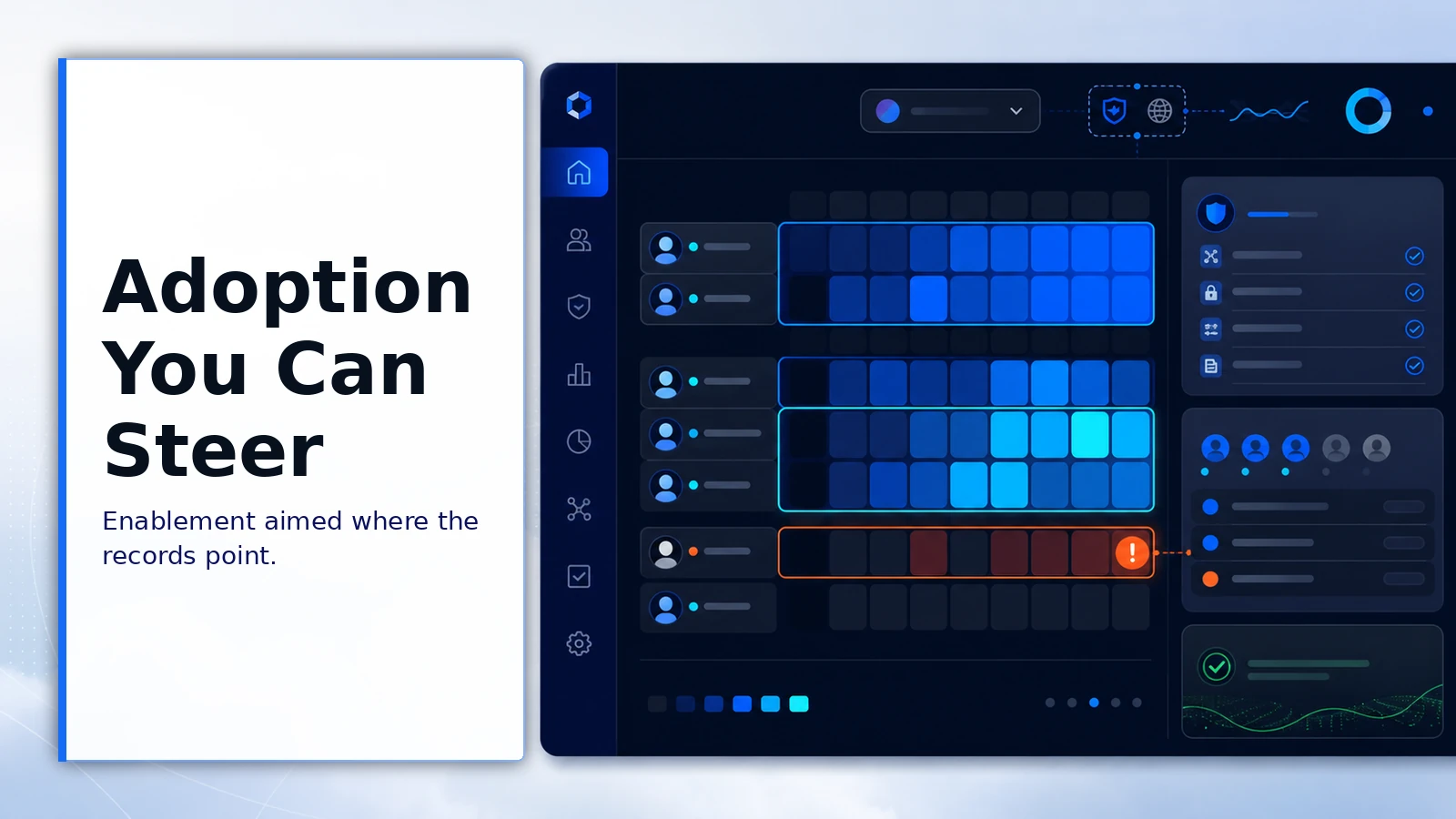
Seeing which teams and workflows carry real usage shows where enablement pays off and where investment quietly stalled.

Reading usage well
Records become decisions when someone asks them the right things:
- Which workflows account for most consumption, and does that match intended value?
- Where is premium-tier usage concentrated, and is the concentration justified?
- Which groups show heavy adoption worth learning from, and which show none worth investigating?
- Do endpoint and API-key patterns match the integrations you believe exist?
- What changed after the last policy or routing adjustment?
Here is the picture doing its job in two roles.
An operations leader reviews usage by workflow and finds document processing consuming most volume on an efficient tier, exactly as designed, while an unplanned premium-tier hotspot traces to one team’s ad hoc analysis habit. The response is a routing conversation, not a crackdown, and it comes weeks earlier than any invoice would have prompted it.
An executive sponsor preparing a board update pulls adoption by group: support and finance deep, legal shallow. The next enablement quarter is aimed where the records point rather than where the loudest anecdotes did.
How the records hold up
-
Six attribution dimensions
Usage records span user, group, model, endpoint, API key, and workflow, covering the questions administrators and finance actually ask.
-
One view across models
Because records accumulate at the routing layer, multi-provider traffic lands in a single picture rather than fragmenting per vendor dashboard.
-
Cost connected to activity
Token tracking ties consumption to spend in the same records, so cost analysis does not require reconciling separate systems.
Where visibility has limits
Records show what happened. They do not judge whether it was worth it. Value assessment still needs humans connecting usage to outcomes, and visibility is the input to that judgment, not a substitute for it.
Coverage follows the layer. Activity outside the governed workspace and routing path is invisible to it, so shadow usage remains a policy and adoption question that visibility informs but cannot solve alone.
And visibility carries a cultural responsibility. Used as measurement, it builds trust and better decisions. Used as gotcha, it teaches people to route around the governed path, which destroys the records everyone depends on. Measure the operation, not the individuals.
Frequently asked questions
What is the difference between usage visibility and monitoring conversations?
Usage visibility is about attributable activity records: who used what, through which models, at what cost. It does not mean reading people’s conversations. The questions it answers are operational and financial, and they are answerable from usage metadata. Content-level review, where it exists, is a separate governance decision with its own justifications.
How does usage visibility support AI cost control?
Visibility is the measurement half; cost-aware routing is the enforcement half. Records show where spend concentrates by user, group, model, and workflow. Routing policy then does something about it, assigning work to the tiers your rules define and holding the limits you set. Together they close the loop: see, decide, enforce, and see again.
Can visibility cover API and integration traffic, not just chat?
Yes. Attribution by endpoint and API key means programmatic usage is recorded alongside workspace usage, so integrations do not become a blind spot in the operation’s picture.
Does this create a surveillance problem?
It does not have to, and it should not. The operational questions, adoption, routing, cost, policy compliance, are answerable at the level of attributable usage, not conversation content. Organizations that communicate that distinction clearly get both the records and the trust. Organizations that blur it get neither for long.
Who should have access to usage records?
The operation’s owner and the finance and security roles that act on them, with summaries flowing to leadership on a cadence. Broad read access to raw records rarely helps and often chills; decision-grade summaries in the right hands do the actual work. Access to visibility is itself an access-control decision, and it deserves the same deliberateness as any other.
Run the operation on records
Every other AI discipline, cost control, access policy, routing strategy, adoption planning, is only as good as its picture of what is actually happening.
Get the picture. Then decide from it.